
Stone instruments: get to know the lithophones
You lithophones They represent one of humanity's most ancient forms of musical expression, uniting raw geology with the acoustic refinement of modern melodic percussion.
Advertisements
In this article, we will explore the fascinating journey of these stone instruments, from archaeological finds in Vietnam to contemporary compositions that utilize resonant rocks in large orchestras.
Summary
- What technically defines a lithophone?
- The science behind the resonance of stones
- Notable historical and geographical examples
- The role of lithophones in current music
- Comparative table of materials and sounds
- Frequently asked questions about the topic
What are lithophones and how do they work?
An instrument classified as lithophones It is essentially an idiophone composed of pieces of stone that, when struck together, produce musical notes with well-defined frequencies.
Unlike a drum, where the membrane vibrates, here the solid body of the mineral itself propagates sound waves through its dense, crystalline molecular structure.
The sound depends directly on the purity of the rock, its internal density, and the way the craftsman carves the piece to achieve a specific and harmonious tuning.
Advertisements
Historically, these instruments were used in spiritual rituals, serving as a sonic bridge between the material and divine worlds in various Asian, African, and European cultures.
Why do certain stones resonate better than others?
The resonance capacity of lithophones It is closely linked to mineralogical composition, with basalt, jade, and phonolite being the preferred rocks for musicians and specialized luthiers.
Rocks with a high silica content or integrated crystalline structures allow the energy of the impact to be transformed into sound, instead of being absorbed by the porosity of the material.
++ How does the Japanese koto work?
Geologists explain that the metallic "feel" of some stones occurs due to the rapid propagation of vibration, a phenomenon that can be studied in depth in portals such as the Mindat.org, a world reference in mineralogy.
The lapidary technique is crucial, as removing small chips from strategic areas of the stone alters the wavelength, allowing the instrument to be tuned to complex scales.
What are the most famous models in the world?
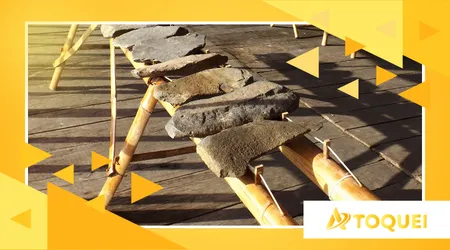
The most emblematic example of lithophones and the Dan Da Vietnamese, whose stone blades date back thousands of years and still preserve an impressive and clear tonal purity.
In England, the "Great Stalacpipe Organ" in the Luray Caves transforms stalactites into a giant keyboard, proving that nature itself can act as an immense musical instrument.
Read more: What is a bandoneon and what is its importance in Argentine tango?
There are also the famous Skiddaw musical stones in the British lake region, which were mounted on xylophone-like structures for royal concerts during the 19th century.
Each culture developed its own suspension methods, using natural fiber ropes or wooden supports to ensure that the vibration was not muffled by contact with the ground.
How are lithophones used in contemporary music?
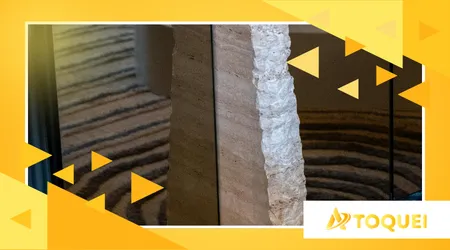
Currently, experimental musicians and film score composers use the lithophones to create organic textures that synthetic or metallic instruments simply cannot reproduce with the same fidelity.
The search for ancestral sounds has led percussionists to rediscover rocks, integrating sets of polished stones into performances that blend jazz, classical music, and regional folk rhythms.
++ Discover the oud, an ancient Arabic instrument.
The modern design of these instruments has evolved into ergonomic structures, facilitating transport and stage setup, while maintaining the acoustic integrity necessary for professional high-definition recordings.
His presence at music festivals around the world reaffirms that the human connection with the earth through sound remains alive, powerful, and in a constant process of artistic reinvention.
Comparison of Materials and Acoustic Properties
| Material | Common Origin | Sound Quality | Main Use |
| Basalt | Volcanic | Deep and sustained | Dan Da and Xylophones |
| Jade | Metamorphic | Crystalline and sharp | Ritual chimes |
| Phonolith | Volcanic | Metallic and short | Portable lithophones |
| Dense Limestone | Sedimentary | Opaque and rhythmic | Floor percussion |
When did the first historical evidence emerge?
Archaeological research indicates that the lithophones They are among the oldest tools on the planet, with examples found in the Sahara and Central Asia dating back to the Neolithic period.
Unlike wood, which rots over time, stone preserves percussion marks, allowing scientists to identify patterns of musical use in objects dating back 10,000 years.
This extreme durability offers a unique window into understanding how our ancestors perceived acoustics and how they organized tonal systems long before the invention of formal musical notation.
Many of these artifacts were mistaken for grinding tools for decades, until wear analyses and sound tests revealed their true and sophisticated melodic and rhythmic function.
What are the advantages of using stone tools?
The main advantage of using lithophones In a composition, the goal is to achieve a unique sonic envelope, characterized by an immediate attack and a decay rich in natural harmonics.
Unlike metal, which sometimes has an excessive shine, the stone offers an "earthy" sound that fills the frequency spectrum in a balanced and extremely pleasant way to the ear.
Beyond the sonic aspect, there is an undeniable aesthetic and visual value, transforming the performance into a multi-sensory event where raw nature takes center stage.
For music educators, the use of stones facilitates the understanding of physical concepts about vibration and matter, making learning music a tactile, visual, and profoundly historical experience.
How to build or acquire such an instrument.
Although it seems simple, creating lithophones It requires patience to find the right stones and technical knowledge to cut them without causing cracks that compromise the internal structure and sound.
Many enthusiasts begin by collecting rocks from riverbeds, testing the sound with small rubber mallets before deciding which piece deserves to be worked on in a fixed support.
Today, there are specialized luthiers who sell kits of pre-tuned stones, allowing any percussionist to integrate these sounds into their repertoire without needing in-depth knowledge of geology.
It is essential that the extraction and use of these materials be carried out ethically and sustainably, respecting the geological and environmental heritage of each region from which they originate.
Conclusion
Exploring the universe of lithophones It's like taking a journey back to the roots of humanity, where music wasn't just entertainment, but a direct extension of the natural elements.
Whether in archaeological museums or on avant-garde stages, the sound of stones continues to echo, proving that musical innovation often lies in the careful observation of the mineral world.
By valuing these instruments, we preserve ancestral knowledge about acoustics and physics, ensuring that future generations can still hear the music that emanates from the very heart of the Earth.
To deepen your knowledge of historical instruments and musical archaeology, visit the website of National Museum, which holds valuable collections about human material culture.
Frequently Asked Questions
What is the difference between a lithophone and a xylophone?
While the xylophone uses wooden bars, the lithophones They use stone blades, resulting in denser tones and significantly superior acoustic durability over the centuries.
Can any stone be used to make music?
No, most stones produce only a dry sound; only rocks with a specific crystalline structure and low porosity, such as basalt, possess the resonance necessary for musical purposes.
Do lithophones require constant tuning?
Unlike stringed or woodwind instruments, lithophones They are extremely stable, maintaining their original tuning for decades unless they suffer serious physical damage or extreme temperature changes.
Where can I listen to music made with stones?
Many contemporary percussion groups and ethnic music orchestras use these instruments in their recordings, and they are commonly found in film soundtracks that seek an ancestral atmosphere.
