How to use tablature: a beginner's guide for guitar and bass.
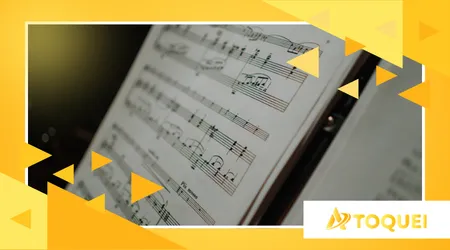
Understanding how to read tablatures It's the watershed moment between those who only dabble in the instrument and those who finally begin to speak the language of the strings. It's the goldmine for the modern guitarist.
Advertisements
This guide goes far beyond simply memorizing numbers.
Let's decipher the visual logic that transforms the guitar neck into familiar territory, allowing you to play complete songs with a fluidity that traditional sheet music often ends up making bureaucratic.
Summary
- The real concept: Tablature as a practical language.
- Anatomy of the lines: Why the visual appears "inverted".
- The logic of houses: Numbers, pressure, and precision.
- Dynamics and expression: Hammer-ons, pull-offs and the soul of the solo.
- Tablature vs. Sheet Music: A Choice of Territory.
- Optimizing your training: How to read and play simultaneously.
- FAQ: Answers to the questions that are hindering your progress.
What are tablatures and why do they dominate hands-on learning?
To the tablatures They don't try to explain music through the physics of sound, but rather through the mechanics of the body.
They show you exactly where to place your finger, eliminating that second of hesitation that happens when you need to translate a theoretical interval into a physical position.
Advertisements
Unlike the traditional system, which requires years of rhythmic literacy, this method is pure visual instinct. It works like an extension of your gaze onto the guitar fretboard.
In 2026, with instant access to thousands of digital files, mastering this reading skill is what guarantees you won't get stuck at the basics.
Agility is key here. While a conservatory student is still identifying a note on the staff, someone who has mastered the... tablatures He's already playing the main riff.
It's a straightforward, no-nonsense approach, designed for those who want sound coming right out of the box as soon as possible.
How to interpret the six lines without getting lost in the visuals?
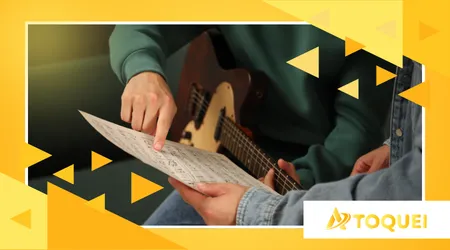
Imagine you're holding a guitar and looking down. The string closest to your eyes is the thickest, right?
In the tablatures, The logic is that, but represented in a mirrored way to make it easier to read on paper or on screen.
The line at the top of the diagram represents the thinnest string (high E). The line at the bottom is the thickest string (low E).
++Review of portable digital tuners
It might seem confusing for the first ten minutes, but there's a reason for that: it's as if the ropes are lying in front of you.
A common mistake is trying to read tablature as if it were a chart from top to bottom. Train your brain to associate the bass note on the paper with the low notes of the instrument.
Once that switch flips, reading ceases to be an effort of translation and becomes an automatic reaction.
What do the numbers really say about your technique?
In the tablatures, The number is the banknote's address. If you see a "5", it's not for using your fifth finger (which we don't even have), but for pressing the fifth position.
It's that simple. The "0" represents freedom: it indicates that the string should sound free, vibrating along its entire length.
The magic happens when the numbers stack up. A column of numbers in different rows requires you to attack all the strings at once. This is where chords are born.
++How to use playback software for home rehearsals
But be careful: tablature is economical; if the number isn't there, you don't play that string. Silence is also music.
Many people are unaware that the positioning within the house makes a difference in the timbre.
Even if the tablature only calls for the 3rd fret, your ear should guide your finger close to the fret, ensuring that the note sounds clean and without that annoying metallic buzzing.
Deciphering the "alphabet soup" of advanced techniques
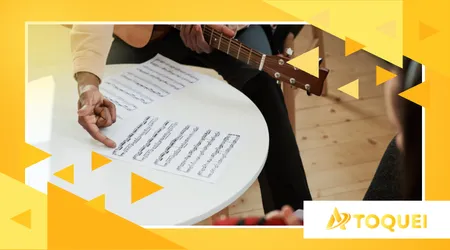
To prevent the music from sounding like a cheap electronic keyboard, you need articulation. tablatures, The "h" (hammer-on) is an invitation to force: you play one note and hammer the next without using the pick.
The "p" (pull-off) is the opposite, a "pull" that requires surgical precision.
The slide (“s” or “/”) is the sliding motion that gives blues and rock a smooth, languid feel, while the “b” in bend is the guitar's scream, raising the note through the physical tension of the string.
Mastering these symbols is what separates a diligent beginner from someone who truly makes the instrument sing.
++How to use scales to improvise in different styles.
To understand how these techniques apply to different instrument models, the Fender Play It offers a technical overview that helps to understand how the physics of the guitar responds to each of these visual tablature commands.
Is tablature enough to be a complete musician?
There is an old debate about the "lack of rhythm" in tablatures. It is true that many of them do not include the time signatures (minims, crotchets).
Therefore, reading tablature requires you to use your ears as your primary guide. It's the map, but the record is your GPS.
In 2026, technology integrated audio files directly into tab viewers, mitigating this problem.
Still, a musician who relies exclusively on seeing the number risks becoming a mere string typist. Developing auditory perception in parallel is what brings maturity.
Don't see tablature as a crutch, but as a smart shortcut. It allows you to learn technical complexities in weeks, something that would take months with sheet music.
At the end of the day, what matters is whether the sound coming out of the amplifier moves the listener.
Comparison: Where Tablature Wins and Where It Loses Ground
Below is an honest analysis of how these writing systems perform in the daily life of a musician seeking versatility and speed.
| Criterion | Tablature | Traditional Score |
| Execution Speed | Instant for beginners | Requires slow decoding. |
| Technical Fidelity | Indicates the exact string. | It can be ambiguous on the guitar. |
| Rhythmic Precision | Dependent on the ear | Absolute and mathematical |
| Universality | Focused on fretted instruments | It works from piano to oboe. |
| Cost of Access | Open and free community | Often academic |
The transition to the next level of reading.
There comes a time when... tablatures Simple instruments start to seem limited. That's when you notice that the same note can be played in three different places on the fretboard, each with a distinct texture and feel.
The tablature chooses one for you, but your ear might suggest another.
Practicing with focus means not just accepting what the number says, but understanding the reason behind that choice.
Playing slowly, with a metronome pulsing in the background, helps to fill in the rhythmic gaps that simplified notation sometimes leaves unnoticed.
The real evolution happens when you stop reading house by house and start seeing patterns. You'll see that a rock solo often follows specific scale patterns.
Then, the tablature ceases to be a rigid guide and becomes merely a reminder of a path you already know.
Tools that transform numbers into music.
Software like Guitar Pro and integrated platforms have changed the game. They allow you to see the tablatures while listening to the isolated guitar track.
It's like having a private tutor who never gets tired of repeating that difficult two-second passage.
By 2026, these tools will already be able to identify your playing via microphone and pinpoint where you're making mistakes in timing or frequency.
Technology has removed the frustration of "I don't know if I'm doing it right," leaving only the enjoyable part of learning.
Take advantage of these resources to dissect seemingly unattainable pieces of music. Reduce the tempo to 50%, understand each slide and each indicated vibrato.
Patience in reading is what builds speed in future execution.
The journey of the ropes
To read tablatures It's a rite of passage. It's the moment when music ceases to be an inaccessible mystery and becomes something tangible, real, and possible to perform in your room.
Don't get stuck on purist rules: use what works for your progress.
Keep your guitar handy and your curiosity sharp. Each new tablature is a new vocabulary that you add to your personal repertoire.
The secret lies not in how quickly you read, but in the clarity with which each note is delivered.
For those who want to understand the architecture behind musical notes and how scales connect to what you see on paper, the website Music Theory It is an indispensable reference for solidifying your foundation and transforming your technique into art.
FAQ – What still often causes confusion?
Does tablature work for bass and ukulele?
Absolutely. The logic is identical: each line represents a string. A ukulele will have four lines, and a bass will too, but the principle of "number equals fret" remains unchanged and universal for these instruments.
How do I identify the beat of the music on tab?
If the tablature doesn't have time signatures (stems), you need to use the original music as a reference. Your ear will tell you if that "3" on the A string is a long note or a fast, percussive beat.
Why do some numbers appear in parentheses?
Generally, this indicates a "ghost note." It's a note that should be felt more than heard, played very lightly, almost percussively, to give balance to the rhythm without overpowering the melody.
Can I compose using only tablature?
Yes, many professional guitarists write their ideas down this way. It's an excellent way to record a riff or chord progression without needing to master sheet music, while preserving the original idea.
