
The impact of group music education in childhood.
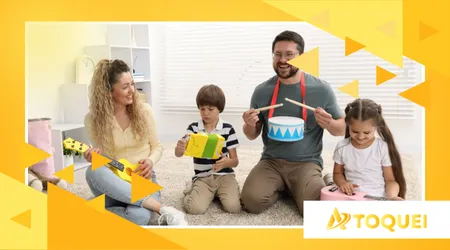
Forget that rigid image of children in rows mechanically blowing flutes.
Advertisements
Today, the impact of collective teaching It is based on active methodologies where the classroom becomes an ecosystem.
Here, learning is not transmitted vertically, from master to student, but rather in a circular fashion.
In this dynamic, the child learns to observe, imitate, and, most importantly, react to the sounds of others.
It is a process of aesthetic literacy that treats music as a living language and not as a static score to be deciphered in isolation.
Advertisements
Group teaching demystifies the elitist idea that music is a "gift" for the few, revealing that harmony is born, above all, from shared effort.
Navigation Summary
- Deconstructing the concept of group classes
- The networked brain: Why does the collective accelerate the mind?
- The orchestra as a micro-society
- Neuroscience in 2026: Evidence of social plasticity
- Practical Parallel: Individual Lessons vs. Group Practice
- Questions that parents often ask
Why does group practice accelerate cognitive development?
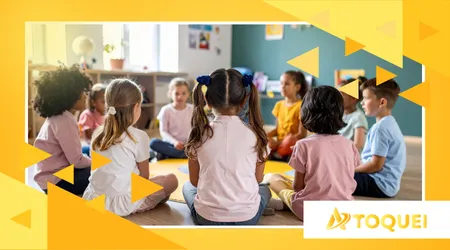
There is something fascinating about what happens to children's reasoning when silence is filled with multiple simultaneous voices.
THE impact of collective teaching The challenge in cognition lies in the requirement for multifocal attention.
While the student performs their part, they are forced to process the pulse of the colleague next to them and the dynamic nuances of the entire group.
This sensory multitasking isn't just noise; it's high-performance training for the brain.
Studies indicate that this constant stimulation strengthens the connections between the brain hemispheres, facilitating the resolution of logical problems and the understanding of abstract structures, such as those found in mathematics and advanced grammar.
++How to use tablature: a beginner's guide for guitar and bass.
Group music teaches the brain to think in layers.
How does collective music strengthen socio-emotional skills?
Music is, in its essence, a tool for negotiation. In the school context, the impact of collective teaching It manifests itself in the visceral need to listen before playing.
For the whole to sound good, the child needs to calibrate their own volume and intention in relation to the whole—a lesson in otherness that many adults have not yet mastered.
There is an almost poetic psychological security in belonging to a violin section or a choir. Individual mistakes cease to be a traumatic burden and become a shared technical skill.
++How to teach body percussion to children in a group.
This reduction of initial aesthetic pressure allows the child to develop resilient self-confidence, where the stage ceases to be a place of judgment and becomes a space for celebration and social belonging.
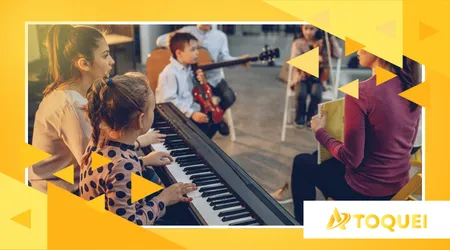
What are the proven neuroscientific benefits in 2026?
Recent advances in brain mapping provide data that confirms what educators have already felt in practice: the impact of collective teaching It physically alters the structure of the auditory cortex.
By 2026, we know that group practice releases spikes in oxytocin and dopamine that are not replicated on the same scale in individual studies.
This brain chemistry promotes neuroplasticity, making learning new languages a much more intuitive task for children who are musically involved in groups.
++Children's songs: cultural and educational importance
The ability to distinguish phonetic subtleties and rhythmic variations in speech is a direct byproduct of hours spent training the ear to play together. It is the brain being sculpted by sonic interaction.
Table: Learning Dynamics and Results
| Pedagogical Variable | Focus on Individual Lessons | Focus on Collective Teaching |
| Social Interaction | Null or limited to the teacher | Consistent and collaborative |
| Active Listening | Focused on its own mistake | Focused on group harmony. |
| Resilience | Focused on technical perfection. | Focused on collective overcoming. |
| Engagement | It depends on external motivation. | Fueled by a sense of group. |
| Access | Often restrictive | Inclusive and democratic |
The role of the educator: From teacher to mediator.
In this context, the role of the music teacher underwent a necessary metamorphosis.
To guarantee the real impact of collective teaching, In this context, the teacher acts less as a judge of technique and more as a mediator of conflicts and potential.
He needs to read the room as if it were a human musical score, identifying where one student's rhythm can propel another's melody.
This approach requires sensitivity to understand that a student's silence may be a sign of reflection, not inattention.
++MUSIC AND CHILDREN: EFFECTS OF MUSIC ON CHILD DEVELOPMENT
By creating a rotating leadership environment, the educator allows the child to experience the weight of responsibility and the joy of collaboration, transforming the music room into a dress rehearsal for adult life.
What is the ideal age to begin group music lessons?
Although the desire to play an instrument can arise at any time, the impact of collective teaching It is especially potent in the window between 4 and 6 years of age.
It is during this period that social plasticity is at its peak and the child is eager for group rituals.
In this initial phase, the instrument is the body itself and the voice. Circle games, body percussion games, and simple songs prepare the muscles and ear for more complex challenges.
What matters is not the precision of the note, but the understanding that its sound is part of something much bigger.
Beyond the grades: The impact on the school community
Implementing collaborative music projects alters the DNA of educational institutions.
THE impact of collective teaching It spills out of the music room, reducing rates of isolation and bullying, since musical practice requires empathy and mutual support to exist.
When a school pauses to listen to its own orchestra or choir, it is celebrating its capacity for organization and harmony.
This creates a sense of institutional pride that resonates with families, who begin to see the school not only as a place of instruction, but as a hub for high-quality cultural and human development.
A look towards the educational horizon.
Understanding the impact of collective teaching It means accepting that music is a fundamental right, not a luxury reserved for the most talented.
By investing in methodologies that prioritize "we" instead of "I," we are giving children the tools to orchestrate their own lives with autonomy and sensitivity.
The success of this educational model is not measured by the number of professional virtuosos it produces, but by the number of empathetic, creative adults capable of listening to the world around them that it returns to society.
Group music is perhaps the most beautiful metaphor for democracy that we can teach a child.
What you need to know
Can group learning hinder individual progress?
On the contrary. The group serves as a motivational accelerator. Seeing a classmate overcome a technical challenge encourages the child to dedicate themselves more, transforming learning into something enjoyable and social, and not into an arduous and solitary task.
How to deal with different skill levels in the same class?
Good educators use multi-level arrangements. In the same piece, there are simple parts for beginners and complex challenges for more advanced students. This teaches that all functions are essential to the final result of the work.
Is it necessary to buy an expensive instrument right at the beginning?
No. Many group teaching projects begin with low-cost instruments or those provided by the institution itself. The initial focus is on rhythmic and melodic perception, which allows for a more conscious and mature choice of the final instrument.
My son is very restless, will group classes work?
Often, restlessness is simply energy seeking an outlet. Group learning provides this outlet through rhythm, helping children channel their energy in a productive and focused way, even improving their concentration in other subjects.
