
Children's music education without screens: modern methods for 2026
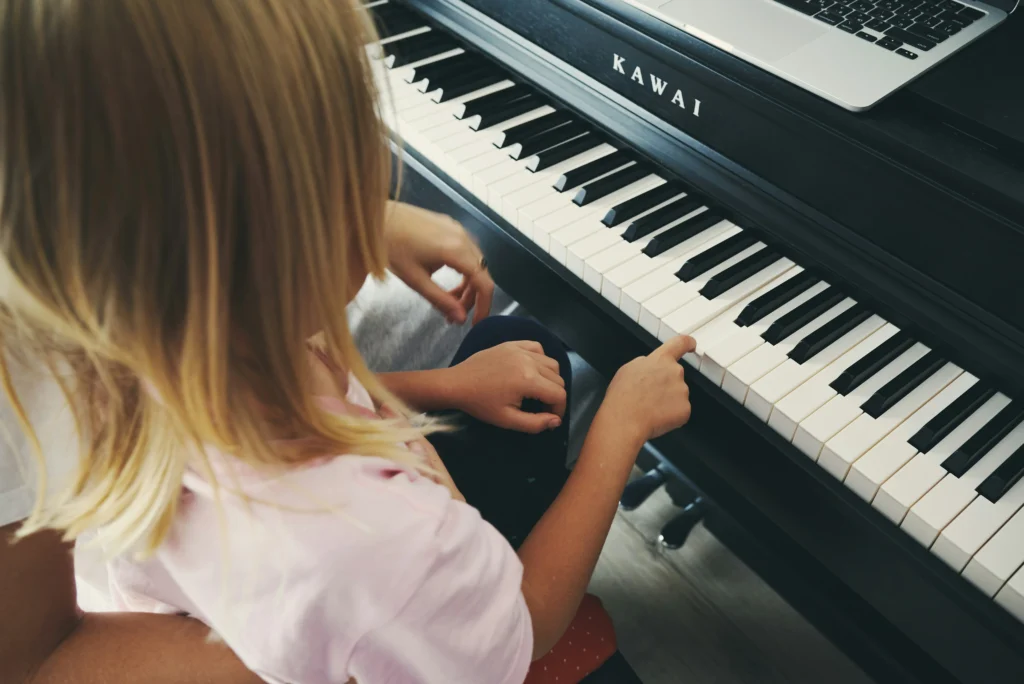
THE Children's music education without screens. It emerges in 2026 as a necessary movement of pedagogical resistance.
Advertisements
In a world saturated with digital stimuli and sensory passivity, educators and parents are rediscovering that true cognitive development happens in the space between the body, the instrument, and silence.
This article analyzes active methodologies that prioritize conscious listening and tactile exploration, which are fundamental for brain plasticity in early childhood.
We will see how the recovery of organic practices strengthens the affective bond and motor coordination, offering practical ways to integrate music into children's daily lives in a profound way, far from the hypnosis of blue lights.
What does screen-free music education for children look like in practice?
This is a sensitization process that uses voice, movement, and real instruments to construct musical thought without the mediation of algorithms.
Advertisements
In the Children's music education without screens., In this way, the child ceases to be a passive spectator and becomes the protagonist of their own sound production.
The focus is on the phenomenological experience of sound.
The vibration of a drum or the timbre of a flute are physically felt, not just heard through low-fidelity speakers.
There is something unsettling about how quickly we replace tactile exploration with screens, and this method seeks precisely to reverse this early sensory disconnection.
In 2026, educators will use the concept of "soundscape" to teach children to identify environmental sounds. This promotes an auditory ecology that the digital world often stifles.
Learning occurs through free play, where mistakes and experimentation are essential parts of a journey of intellectual and emotional discovery.
How does the body become the first musical instrument?
Methodologies such as that of Émile Jaques-Dalcroze teach that rhythm is a muscular experience before it is a mathematical notation on paper.
In the Children's music education without screens., Walking, jumping, and clapping translate complex concepts of pulse and time into a child's body language.
This body-based approach stimulates the cerebellum and motor areas in an integrated way, developing a sense of space and time that the interfaces touch They are unable to replicate it.
Read more: Complete Guide on How to Choose Your First Musical Instrument
The body learns to react to sound in real time, creating a robust neural connection that will serve as the foundation for any future learning, from mathematics to writing.
To understand the scientific basis of child development and Brazilian pedagogical guidelines, the portal of Ministry of Education (MEC) It offers essential documents about the National Common Curriculum Base (BNCC).
These texts reinforce how vital the arts and movement are in the basic curriculum.
Why avoid digital resources in early music education?
Excessive use of electronic devices can cause dopamine overload, making it difficult to concentrate in order to listen to more subtle nuances and timbres.
THE Children's music education without screens. It protects the development of sustained attention, allowing the child to appreciate silence and the dynamic variations of music without rushing.
Often, digital content for children is visually overstimulating, which ends up distracting auditory perception instead of training it.
By removing electronic visual aids, we force the brain to create its own mental images, strengthening imagination and the capacity for creative abstraction.
Furthermore, direct human interaction during musical practice promotes the development of empathy and nonverbal communication.
Playing with a rattle with an adult creates a social mirroring that no digital avatar can simulate, consolidating affective memories that social networks will never be able to replicate.
Organic Music Education Activities by Age (2026)
| Age Range | Educational Objective | Suggested Activity | Materials Needed |
| 0 to 2 years | Timbral Sensitization | Sound bath and musical massage | Bells, fabrics and seeds |
| 2 to 4 years | Pulse and Coordination | Rhythmic marches and imitation | Wooden claves and drums |
| 4 to 6 years | Perception of Height | "High and low" games“ | Xylophone or glasses of water |
| Above 6 years old | Collective Creation | Improvisation and short compositions | Recorder or body percussion |
| All ages | Active Listening | Sound walk in the backyard/park | The environment itself and the silence |
What materials could replace music apps?
Natural materials such as stones, shells, and branches offer a richness of sonic textures that no digital synthesizer can reproduce.
Using these elements in Children's music education without screens. It teaches the child to value sustainability and to observe the hidden music in the simplest everyday objects.
High-quality percussion instruments, such as metallophones and chimes, should be introduced so that the ear becomes accustomed to pure frequencies.
This is often misinterpreted as a "luxury," but it is actually an investment in hearing acuity that directly impacts literacy and speech fluency.
Learn more: Best free apps for studying music at home
The crafting of handmade instruments within the family also holds immense educational value: the object's worth lies in the time invested in its creation.
A drum made from recycled material possesses a symbolic charge and a physical response that engages the child in a way that is incomparably more powerful than any screen.
How can I integrate music into my routine without relying on videos?
The key is to transform everyday tasks, such as tidying up toys or preparing snacks, into moments of singing and spontaneous rhythmic exploration.
Practice Children's music education without screens. Playing at home doesn't require parents to be professional musicians, but rather that they are present and willing to experiment with sound.
Small rituals, such as lullabies or wake-up music, help regulate a child's biological clock and reduce anxiety.
Using physical albums or screenless audio devices allows the music to be the soundtrack, not the main visual distraction in the environment.
To explore references on the impact of music on the brain and studies in applied neuroscience, the website of Brazilian Association of Music Education (ABEM) It is an indispensable source.
Access to recent research helps validate the effectiveness of methods that prioritize direct human and auditory contact over digital means.
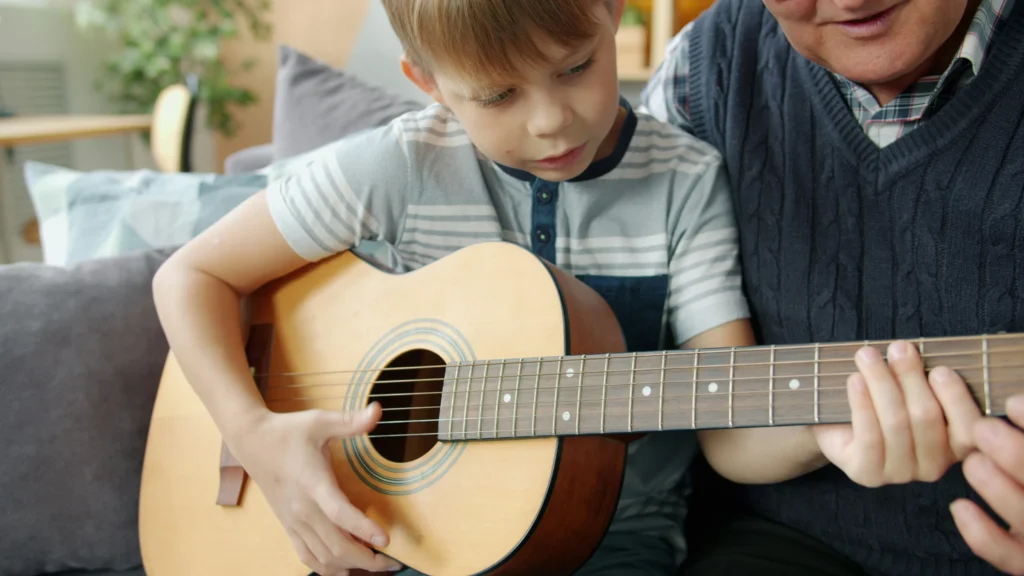
THE Children's music education without screens. In 2026, it represents more than a teaching technique; it's a reclaiming of our sonic humanity.
By prioritizing the body and active listening, we offer children the tools for robust mental health and boundless creativity.
It's not about rejecting technology altogether, but about ensuring that the foundations of human development are built on fertile and tangible ground.
Silence, the rhythm of the heart, and the sound of one's own voice are the greatest teachers a young apprentice can have.
Read more: How to use soundtracks to regulate emotions in children
May we learn to silence our devices to listen to the music that arises from real interaction, protecting the sacred right to play and grow authentically.
FAQ: Frequently Asked Questions about Screen-Free Music Education
What is the best instrument to start learning music at home?
Percussion instruments, such as small hand drums, wooden claves, or metal eggs (shakers), are ideal because they allow for an immediate and intuitive motor response.
How can I tell if my child has musical talent without using testing apps?
Talent manifests itself in auditory curiosity, ease in reproducing rhythms with the body, and attention to detail when listening to complex sounds. Observing free play is the best way to diagnose it.
Can I use smart speakers like Alexa to play music?
Yes, as long as the focus is solely on audio. Using voice commands encourages autonomy, allowing the child to choose what to listen to without being hypnotized by visual stimuli.
How much time per day should I dedicate to these activities?
There is no set time, but short sessions of 15 to 20 minutes of focused interaction are usually more effective in maintaining interest and educational absorption in childhood.
