
How to use a tambourine in fast-paced samba with clean fills.
Mastering the technique for Using a tambourine in fast-paced samba It demands much more than just speed; it requires refined coordination between the wrist and the drumstick to maintain the purity of the tone.
Advertisements
In this 2026 technical guide, we will explore the essential fundamentals for those who wish to elevate their performance level in samba school drumming or in samba circles with high rhythmic demands.
Our technical journey will cover proper ergonomics, the physics behind the perfect "carreteiro" (a specific type of rhythmic movement), and the mental strategies for maintaining rhythmic consistency at tempos exceeding 140 BPM.
You will learn how to avoid muscle fatigue and how to execute fills that cut through the sonic mass with surgical precision, ensuring a clean and professional sound.
How do you hold a tambourine to achieve high speeds?
The initial secret to Using a tambourine in fast-paced samba It lies in the economy of movement, avoiding unnecessary tension in the shoulders and trapezius muscles that restrict the fine muscles of the wrist.
Advertisements
The hand holding the instrument should be firm, yet relaxed, allowing the index finger to help control the damping and resonance of the synthetic skin.
Many beginner percussionists make the mistake of pressing the drumstick too hard, which produces a snappy, lifeless sound and increases the risk of repetitive strain injuries.
In 2026, flexible nylon drumsticks remain the preferred choice of masters, as they offer the necessary rebound for playing fast notes without requiring brute force.
Holding the instrument at a slightly inclined angle relative to the body facilitates the stick strike and the visualization of the wrist rotation movement (the "turn").
This strategic tilt allows gravity to work in your favor, transforming each touch into a fluid and natural movement, essential for fast tempos.
What is the correct mechanics for a truck to avoid a dirty sound?
The "carreteiro" is the soul of the modern tambourine and consists of rotating the instrument while the stick maintains a constant and rhythmic attack plane.
To achieve a crystal-clear sound, the synchronization between the right-hand strike and the left-hand rotation must be absolute, avoiding "mashed" or out-of-time strokes.
To the Using a tambourine in fast-paced samba, The clarity of each note is what separates an amateur musician from an elite rhythmist from the major samba schools of Rio de Janeiro and São Paulo.
Practicing with a metronome, starting at slow tempos and gradually increasing, is the only way to ensure that the rhythmic subdivision remains balanced and powerful.
According to studies of Brazilian percussion available on the portal of Funarte, The tambourine technique evolved to prioritize rhythmic clarity over excessive volume.
The focus should be on the sharp, dry "snap" that defines the instrument's identity within the complex polyrhythms that make up the samba genre.
Technical Parameters for Professional Tambourine (2026)
| Technical Element | Ideal Configuration | Performance Objective |
| Skin Tension | High (Nylon/Plastic Skin) | Sharp projection and rapid response. |
| Drumstick Type | Nylon with 5 to 7 rods | Flexibility for fast truck drivers. |
| Target Progress | 142 to 148 BPM | Standard speed for competitive parades. |
| Wrist Movement | 180-degree rotation | Alternating notes with clear sound. |
| Angle of Attack | 45 degrees in relation to the skin. | Better use of natural rebound. |
Why does the tuning of the tambourine influence the clean fill?
A poorly tuned tambourine requires more force from the musician to produce a sound that stands out, which inevitably compromises technique and the clarity of the fills.
The drumhead must be extremely taut so that the drumstick responds instantly to the touch, allowing quick attacks on the drumsticks to sound crisp and bright.
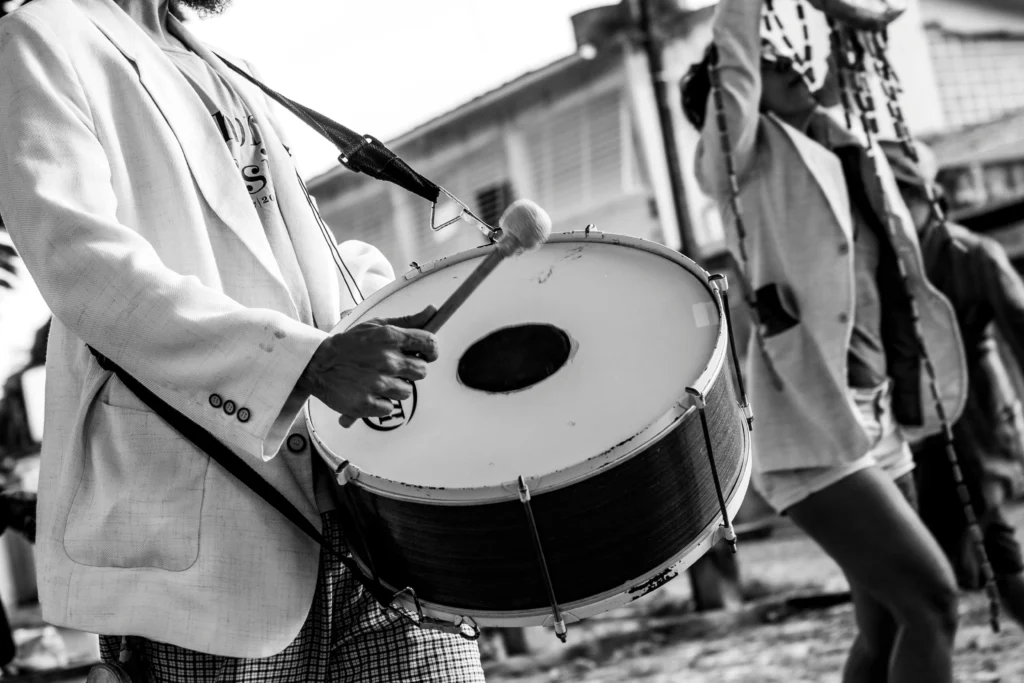
The turns, or rhythmic patterns, require abrupt stops and accents that depend on the immediate response of the drumhead to avoid becoming muddled in the samba.
Read more: How to play reco-reco in samba and choro circles
If the voltage is low, the sound will have a long decay (the metallic "hum"), which impairs the perception of ghost notes and fundamental syncopations of the genre.
To Using a tambourine in fast-paced samba With expertise, the percussionist must check the tuning on all the screws of the rim, ensuring that the tension is uniform.
This avoids unwanted harmonics that can muddy the group's acoustic mix, allowing the "groove" to be felt with pressure and swing by all listeners.
Which exercises improve the accuracy of high-speed turns?
Rhythmic precision at high tempos is built through muscle memory and the conscious repetition of short phrases that make up the most common drumming conventions.
Begin by practicing isolated accents on beat one and beat two, ensuring that the volume of the accent is significantly higher than the fill notes.
Using the "adapted rudiments" technique for the tambourine helps develop hand independence and the agility needed for more complex fills.
Read more: The Role of the Tamborim in Samba Schools: Sharp, Agile and Vital
The double-stroke exercise and the "paradiddle" adapted to the tambourine's rotational movement are excellent for strengthening the forearm muscles and improving fine motor coordination.
Maintaining an upright posture and controlled breathing is also vital for executing clean rhythmic patterns, as muscle oxygenation prevents cramps.
On the website of Order of Musicians of Brazil, Here you will find guidelines on occupational health for musicians, which are essential for anyone who regularly plays instruments with high rhythmic intensity.
When should you use muting to create dynamics in samba?
Using the index or middle finger of the left hand under the skin allows for the creation of rhythmic nuances that enrich the performance and add depth to the samba.
Alternating between open and muted notes creates a melodic line within the rhythm, something essential for accompanying singers and soloists on other instruments.
This alternation of timbres helps to define the phrases and adds "spice" to the performance, preventing the instrument from sounding like a monotonous machine gun of high-pitched snaps.
Learn more: Samba-reggae instruments: how they are organized in the batucada (percussion ensemble).
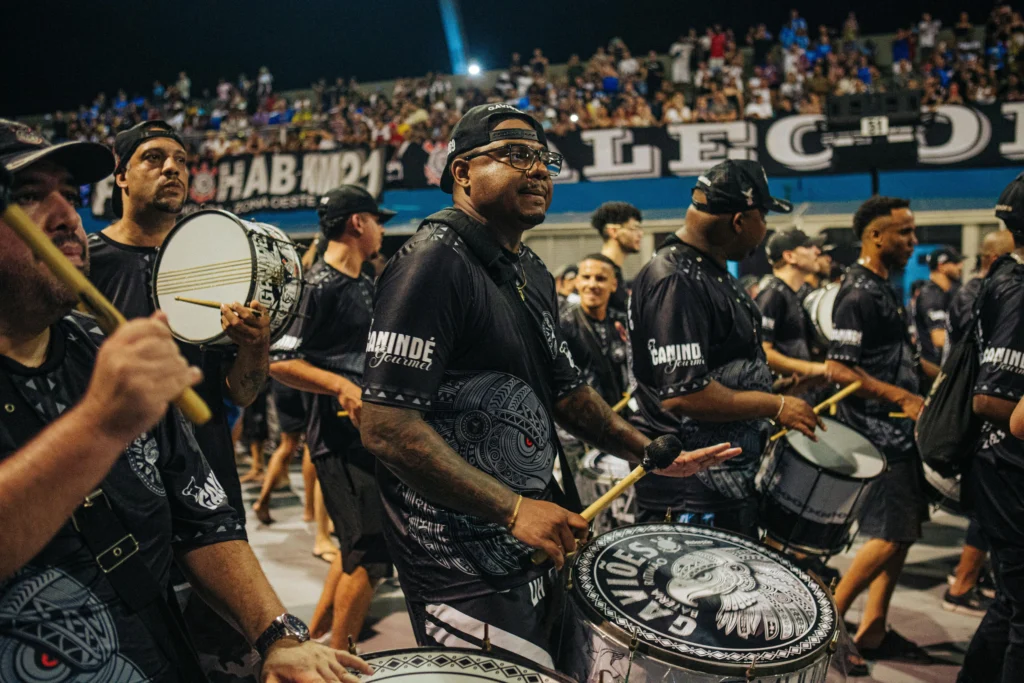
To the Using a tambourine in fast-paced samba, Strategic muting also serves to signal section changes in the music, functioning as non-verbal communication between the drummers.
Practice controlling the pressure of your finger on the drumhead while keeping the rhythm flowing, aiming for a clear contrast between the bass and treble frequencies of the tambourine.
This dynamic versatility is what characterizes the great masters of the instrument, capable of playing with force on the avenue or with extreme subtlety in a traditional samba gathering.
FAQ: Frequently Asked Questions about Tambourine
How can I prevent my hand from getting tired when playing fast samba?
Fatigue is usually caused by excessive force and lack of rotation technique; use the stick's rebound to your advantage. Keep your shoulders relaxed and focus the movement only on your wrist and fingers, slightly alternating the pressure of your grip to allow blood circulation during the performance.
What's the best drumhead for playing tambourine in 2026?
Single-ply, highly tensioned synthetic drumheads remain the standard for their durability and the sonic brilliance they offer in the high frequencies. Some modern brands use compounds that better withstand variations in humidity and temperature, maintaining stable tuning for much longer during outdoor performances or parades.
Is it possible to learn the oxcart driver technique on your own?
Although videos and tutorials are helpful, supervision by an instructor or experience playing in a tambourine circle dramatically accelerates learning the correct mechanics. Direct observation of wrist angle and immediate audible feedback from experienced musicians are irreplaceable tools for correcting postural habits that hinder speed progression.
Mastering the art of playing the tambourine is an ongoing process of auditory and physical refinement, where patience and discipline in daily practice yield surprising results.
By focusing on ergonomics, precise tuning, and clarity of sound, you ensure a performance that not only impresses with its speed but also delights with its sonic clarity.
Dedication to Using a tambourine in fast-paced samba With technique and rhythmic responsibility, you will reach a new level within the Brazilian percussion universe in 2026.
Remember that samba is a rhythmic conversation, and your tambourine should be the clear, bright voice that guides the cadence of the music with authority.
Practice with passion, respect traditions, and always be open to innovations that keep our percussion as one of the richest and most respected in the entire world.
