
Discover the oud, an ancient Arabic instrument.
Summary
- What defines the sound of the Arabic lute?
- What is the history and origin of this instrument?
- How does design influence acoustic performance?
- What are the differences between the regional styles?
- Comparative table: Arabic Oud vs. Turkish Oud.
- Frequently Asked Questions (FAQ).
What is oud and why is it essential?
Considered the "king of instruments" in Arab culture, the oud It stands out as the direct precursor of the European lute and, consequently, of the modern guitar as we know it today.
Advertisements
Its most striking physical characteristic is the absence of frets on the neck, which allows the musician to explore essential microtones in the oriental scales known as Maqamat.
Unlike Western tempered instruments, this chordophone offers unparalleled melodic freedom, allowing for glides and ornamentations that express deep emotions with unique vocal precision.
The sound is deep, rich in harmonics, and possesses a natural sustain that resonates through its pear-shaped body, constructed from select fine woods.
By 2025, interest in ethnic instruments had grown exponentially, placing this classic instrument at the center of productions that blend jazz, electronic music, and folk.
Advertisements
What is the historical origin of this ancient instrument?
The trajectory of the oud It dates back to ancient Mesopotamia, with archaeological records suggesting its existence for over 3,500 years in civilizations such as the Akkadian.
During the Islamic Golden Age, the instrument was perfected by musical theorists such as Al-Farabi, who documented its acoustic properties and significantly expanded playing techniques.
Upon arriving in the Iberian Peninsula through the Moorish occupation, it was adapted and gave rise to the Renaissance lute, forever changing the course of European classical music.
Currently, institutions such as The Metropolitan Museum of Art They preserve historical specimens that narrate this technical and aesthetic evolution through the silk trade routes.
This cultural heritage is not merely for museum purposes, as the instrument remains the theoretical foundation for music students throughout the Arab world to this day.
Read more: Discover the guzheng, the Chinese harp thousands of years old.
How does acoustic structure and anatomy work?
The body of the oud It is a work of luthier engineering, consisting of a lightweight shell made of glued strips of wood, usually maple, walnut or rosewood.
Its soundboard, usually made of spruce, has two or three openings called "rosettes," which are richly ornamented and fundamental to the projection of its characteristic sound.
Unlike an acoustic guitar, the bridge is fixed directly to the soundboard, and the strings are attached in such a way that the tension is evenly distributed across the lightweight structure.
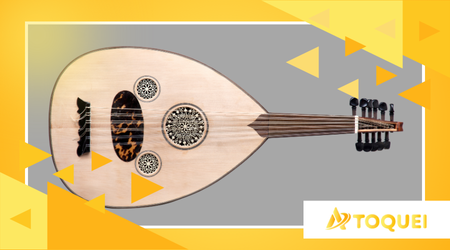
The neck is short and ends in a headstock angled at almost 90 degrees, an iconic feature that helps maintain the tuning of the ten or twelve strings.
Traditionally, the following is used: risha, a plectrum originally made of eagle feathers, but which today is manufactured with high-performance synthetic materials for greater durability.
++ What is a bandoneon and what is its importance in Argentine tango?
What are the most important regional variations?
There are clear distinctions between the models, the oud Arabic and Turkish are the two main languages that dominate the professional and academic landscape today.
The Arabic model tends to be larger, with a deeper, fuller, and more resonant sound, ideal for vocal accompaniment and performance style. taqsim.
The Turkish variant, on the other hand, is slightly smaller, tuned a tone higher, resulting in a brighter, more tense sound that is more conducive to rapid ornamentation and virtuoso techniques.
Modern musicians in 2025 often choose their instruments based on their desired repertoire, seeking a balance between classical tradition and the needs of studio recording.
In addition to these, there are the Persian models, known as Barbat, which have a more elongated body and a distinct sonic aesthetic that harks back to older roots.
++ Typical of the Christmas Orchestra: Besides the Bell and the Violin
Technical comparison between main models
Below, we present the technical specifications that differentiate the two most influential schools of manufacturing and execution of this magnificent instrument in the contemporary global scene.
| Feature | Arabic Oud (Egyptian/Iraqi) | Turkish Oud (Anatolian) |
| Body Size | Large and deep | Medium and shallower |
| Rope Length | 60 cm to 62 cm | 58 cm to 58.5 cm |
| Standard Tuning | Lower (e.g., C2 to F3) | Higher pitch (e.g., D2 to G3) |
| Stamp | Hot, deep and "dry"“ | Bright, shrill, and metallic. |
| String Tension | Low or moderate | High voltage |
Why learn to play this instrument today?
Master the oud It opens doors to a much broader understanding of harmony and melody, challenging the Western perception limited only to major and minor scales.
Playing this instrument develops a refined auditory perception, necessary to identify and reproduce the quarter-tone intervals present in traditional Eastern music.
In a music market saturated with digital sounds, the organic and earthy texture of this stringed instrument offers a valuable creative edge for composers and arrangers of film scores.
Beyond the technical aspect, playing this lute fosters a deep cultural connection, serving as a bridge for dialogue between different traditions and peoples around the world.
Many Brazilian enthusiasts find in the instrument's versatility a way to enrich local genres, such as choro or northeastern music, creating absolutely innovative and rich sonic fusions.
How do you choose your first instrument?
For those who wish to start in oud, The choice should prioritize the luthier's background and the quality of the wood, avoiding purely decorative instruments sold in tourist markets.
It is essential to check the string height in relation to the fretboard, as an action that is too high makes it difficult to play notes accurately and tires the hand prematurely.
It is recommended to start with a standard Arabic model due to its sonic versatility and the wider range of teaching methods available for beginner and intermediate level students.
Consider investing in a quality hard case, as the instrument's structure is extremely lightweight and sensitive to sudden changes in humidity and ambient temperature.
Following specialized communities and discussion forums can help identify reliable vendors and understand the maintenance nuances needed to preserve acoustic longevity.
Conclusion
THE oud It is not merely a musical object, but a living historical document that continues to thrill audiences worldwide with its ancestral voice and profound expressiveness.
Whether you're a professional musician seeking new textures or an enthusiast of Arabic culture, this instrument offers a journey of sonic discovery unparalleled in history.
By integrating tradition and modernity, he proves that music is a universal language capable of transcending geographical and temporal boundaries with elegance, beauty, and great technical sophistication.
Frequently Asked Questions
How many strings does a professional oud guitar have?
Most have 11 strings, arranged in 5 pairs in unison and a single lower-pitched string, although modern models with 12 or 13 strings exist.
Is it difficult for a guitarist to learn the instrument?
The transition is facilitated by prior knowledge of strings, but the biggest challenge is adapting to the lack of frets and the specific picking technique with the... risha.
What is the best wood for a harmonic tabletop?
Spruce is widely considered the best choice due to its ability to vibrate freely and produce a clear, balanced tone with excellent projection.
How is this lute tuned?
The tuning varies according to region and style, but the most common in the Arabic model follows the sequence of notes D2, G2, A2, D3, G3, C4 from bottom to top.
