
What is santoor and how is it played in India?
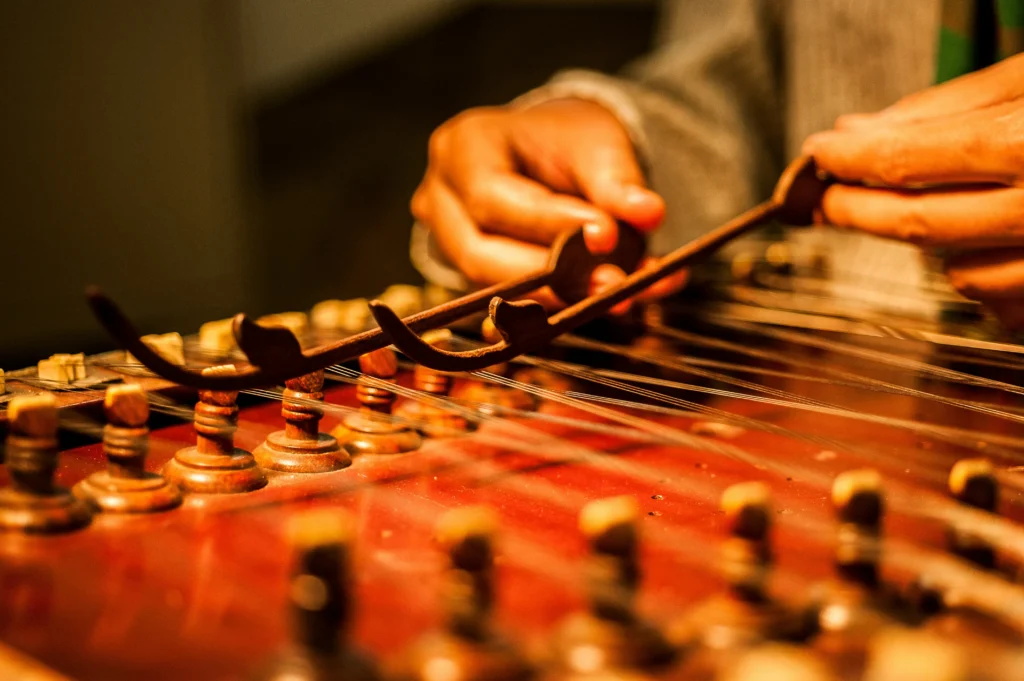
THE saintor It is much more than a simple stringed instrument; it functions as the crystalline voice of the Kashmiri mountains which, through the insistence of great masters, has conquered concert halls around the world.
Advertisements
In 2026, its ethereal sound continues to fascinate listeners by successfully uniting Sufi tradition with the sophistication of modern Hindustani classical music.
This article explores the anatomy of this percussion psaltery, the secrets of its visceral technique, and how it migrated from regional folklore to global stardom.
Let's delve into the history of musicians who defied the conventions of their time to give this instrument the prominence it enjoys today at major international festivals.
What is santoor and what is its origin in Indian culture?
Originally known as Shata Tantri Veena, or the hundred-string harp, the saintor It has roots firmly planted in the soil of Kashmir, where it served as a mystical accompaniment to Sufi music.
Advertisements
Its trapezoidal structure and percussive attack place it in a category of its own, distinguishing it from other Indian icons such as the sitar or sarod, which rely on fingernail or plectrum plucking.
Although there are close cousins in Iran and China, the Indian version underwent profound adaptations to meet the demands of classical music.
This evolution allowed the instrument to express the dense ornamentation and microtonalities of the ragas.
There's something fascinating about this transition: what was once a rustic village accompaniment has become a learned soloist capable of silencing audiences in London or Mumbai.
How is the santoor constructed and what materials are used?
Build a saintor A good piece requires almost surgical precision and the use of woods that can withstand the absurd pressure of dozens of taut strings.
The trapezoidal body is usually carved from walnut or mulberry wood, chosen not only for its aesthetics, but also for its mechanical strength and resonance properties that give body to the sound.
On the soundboard are the bridges that support between 87 and 100 steel and bronze strings, arranged in choruses of three or four.
This configuration creates a sound rich in harmonics that seem to float in the air long after the impact of the small curved mallets. mezrabs.
Without the use of high-density wood, the instrument simply wouldn't withstand the tension necessary to achieve its brilliance.
What are the fundamental techniques for playing the instrument?
Master the saintor It requires fine motor coordination that is almost impossible for a beginner, since the musician needs to hit tiny targets with wooden mallets.
Unlike a piano, you don't have automatic dampers; the control of the "sound cloud" is done entirely by the force, angle, and speed of each stroke delivered by the performer.
Learn more: How to adapt complex songs for beginners
This is often misinterpreted as a purely percussive technique, but the real challenge lies in the melody.
Produce the meand (Indian glissando) on fixed strings requires the master to use quick and precise tremolos to deceive the ear.
It's an acoustic illusion that creates the sensation of one note sliding into another, something vital to the soul of Indian classical music.
Technical Specifications and Regional Differences (Data 2026)
| Feature | Indian Santoor (Classic) | Persian (Iranian) Santur |
| Number of Strings | Generally between 87 and 100 | On average, 72 strings. |
| Body Material | Walnut or Mulberry | High-density walnut |
| Execution Position | Sitting on lap or with a very low base. | Supported on a table or high stand. |
| Mallets (Mezrabs) | Heavier, without felt tips | Lighter, thinner and more delicate |
| Musical Application | Hindustani Ragas and Sufi Music | Persian Classical Music (Radif) |
| Sound Support | Long, dense, and full of harmonics. | Drier, shorter, and more defined |
Why did the santoor take so long to be accepted in classical music?
For decades, the saintor He was rejected in more conservative circles because, theoretically, he couldn't sustain long notes or imitate the human voice—the ultimate goal of any instrumentalist in India.
Purists viewed it as a "hammer box" incapable of expressing the devotion demanded by a classic raga.
Learn more: Discovering the Ocarina: From Zelda to Classical Music
It took profound technical innovations in the mid-20th century to break down this prejudice.
The change in stringing and the way the mallets were held proved that the instrument's versatility was vast.
Today, that initial distrust seems like just a footnote in the story.
For those who want to see the physical evolution of these pieces up close, the Indian Music Experience Museum It maintains a technical collection that is a lesson in applied acoustics.
Who are the greatest exponents of this instrument in history?
To speak of this psalter without mentioning Pandit Shivkumar Sharma would be like speaking of physics without mentioning Newton.
He was the architect of saintor modern, modifying its structure to make the sound sweeter and deeper, ideal for large concert stages.
He lifted the instrument from the Kashmiri soil and placed it under the world's spotlight.
Currently, his son Rahul Sharma and other disciples carry the torch, blending classical sound with elements of jazz and electronic music.
This constant renewal prevents the instrument from becoming a museum piece.
It remains alive, vibrant, and, above all, adaptable to new auditory sensitivities without selling its spiritual essence for any price.
How is the instrument used today?
Today, the saintor It has a guaranteed presence in both Bollywood soundtracks and deep meditation therapies, thanks to its frequencies that seem to calm the nervous system.
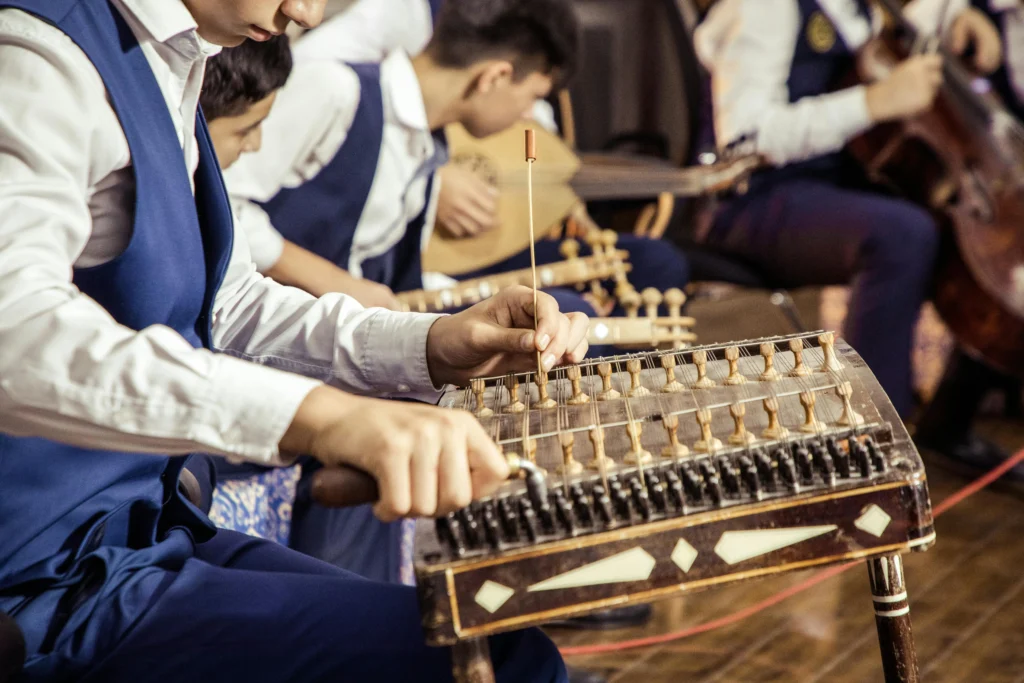
In classical concerts, it is usually paired with the tabla, creating a frenetic rhythmic dialogue that is one of the most anticipated moments for the audience.
Read more: Tabla: The Rhythmic Soul of Indian Music
The expansion beyond scholarly circles demonstrates the resilience of an object that, although thousands of years old, perfectly aligns with the contemporary search for well-being and connection.
For those who wish to study seriously, the Sangeet Natak Akademi He remains the ultimate authority, offering guidelines for those who want to venture down this path of rigorous discipline and sonic beauty.
THE saintor This proves that innovation doesn't have to destroy tradition; it can, in fact, save it from oblivion.
Understanding its strings is understanding a bit of the Indian soul itself, where music is not entertainment, but a bridge to something greater.
If you have the chance, listen to a raga performed at dawn; the experience of seeing the sound cut through the silence with the lightness of a walnut mallet is something that stays etched in your memory for a long time.
Let yourself be enveloped by this vibration that, although born in the mountains, knows no boundaries.
FAQ: Frequently Asked Questions
Is the santoor an accessible instrument for someone starting from scratch?
To be honest: no. It demands an ungrateful level of motor coordination, and you need a very sharp ear to handle the tuning of almost a hundred strings. It's a path of years of daily practice before you can produce your first clean melody.
What is the most obvious visual difference between the Indian and Iranian models?
The Indian accordion is noticeably larger and more robust, designed to be played on the lap. The Iranian accordion (santur) is more delicate, has fewer strings, and requires the musician to play while seated at a table.
How long does it take to tune an instrument before a show?
It depends on the musician's skill, but on average it takes 30 to 60 minutes. As the tuning varies according to the chosen raga, the instrumentalist spends a good part of the pre-concert time with the tuning key in hand.
Can you play Western scales on it?
It's possible, but with limitations. The arrangement of the strings on fixed bridges makes rapid chromatic changes difficult. It truly shines in modal scales and the rich variations of oriental music.
Where can I find a quality Santoor to buy?
The best ones come from artisans in Srinagar or Delhi. The secret is to check the density of the walnut and the precision of the tuning pegs; if they are loose, the instrument will never hold its tuning, becoming a technical nightmare.
