
The secret to the sound of the alfaia drum: how tuning completely changes the maracatu.
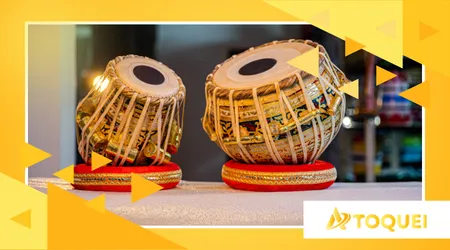
THE The secret of the alfaia's sound It resides in the precise tension of the strings, a technical balance that defines the rhythmic identity of the maracatu de baque virado nations.
Advertisements
Unlike industrial tools, alfaia uses animal hides, usually cow or goat. This organic choice is the first step in understanding the... The secret of the alfaia's sound today.
Summary
- What defines the timbre of the alfaia drum?
- How does moisture affect leather?
- What role do the strings play in tuning?
- Why does tuning vary between nations?
- How to perform preventive maintenance?
What defines the sonic depth of the alfaia?
The alfaia is not just a wooden drum; it is an instrument of complex resonance. The body, usually made of light wood such as macaíba, needs to vibrate freely.
The thickness of the leather determines whether the sound will be deeper (bass) or mid-range (medium). Thicker leathers require more manual traction, but deliver that characteristic sustain of the strum.
The correct assembly of the wooden hoops also influences the process.
Advertisements
If the rim is not perfectly level, the pressure will be uneven, causing unwanted harmonics that impair overall performance.
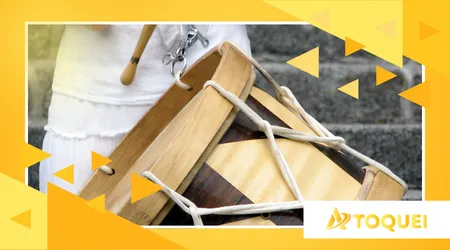
How does climate variation alter the tension of leather?
In 2026, we observe intense climate variations that directly affect organic materials. Leather is hygroscopic, meaning it constantly absorbs moisture from the air.
On rainy days, the leather fibers naturally relax. This causes the sound to become "loose," losing the attack necessary to cut through the sound of neighboring instruments in the procession.
On the other hand, excessive heat shrinks the fibers. If the implement is stretched extremely under strong sun, the risk of the leather tearing or the hoop warping increases significantly.
Master the The secret of the alfaia's sound It requires the percussionist to know how to adjust the tension according to the environment. It's a constant relationship between the musician and the laws of physics.
Why is the string system superior to metal tuners?
Many beginners question why maracatu preserves strings instead of using screws. The technical answer involves the distribution of force and the instrument's own sonic aesthetic.
Polypropylene or sisal ropes distribute tension throughout the circumference of the wood. This prevents localized stress points, preserving the integrity of the instrument's body for decades.
++ Tambor-onça: the Brazilian "cousin" of the cuíca and its role in bumba meu boi.
Furthermore, the "V" or "N" tightening mechanism allows for fine manual adjustment that metal screws rarely achieve. The resonance of the wood is preserved without the interference of heavy hardware.
Feeling the vibration of the string under one's hands is a fundamental part of the master's connection with the instrument. This artisanal handling is the true art. The secret of the alfaia's sound.
What are the fundamental frequencies of each type of alpha?
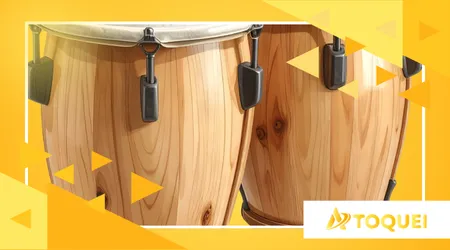
To ensure harmony within a maracatu group, each drum size must occupy a specific frequency range. This prevents the sounds from overlapping in a confusing way.
| Type of Tools | Function in the Baque | Common Diameter | Target Frequency (Hz) |
| Marking (Serious) | Maintaining the rhythm | 20″ to 22″ | 60 Hz – 80 Hz |
| Socks (Answer) | Counterpoint and balance | 18″ | 100 Hz – 140 Hz |
| Haircut (Layered) | Phrases and improvisations | 14″ to 16″ | 160 Hz – 200 Hz |
How does tuning differentiate the Maracatu nations?
Each Maracatu de Baque Virado group has its own "sound signature". The secret of the alfaia's sound In the Puerto Rico Nation, for example, it differs from the Bright Star Nation.
++ Marimba from Pará: how the instrument became a symbol of Amazonian music
Some communities prefer an extremely high, almost dry tuning, emphasizing the speed of the attacks. Others prioritize the deep bass that reverberates in the chest of those who hear the procession pass by.
This choice is not random, but based on centuries of oral tradition. The master decides the ideal tension so that the ensemble sounds like a powerful and cohesive unit.
To understand these technical and historical nuances, you can explore the collection of... National Institute of Historic and Artistic Heritage (IPHAN), which documents the importance of these traditions.
When is the right time to change the strings and the leather?
Preventive maintenance avoids surprising percussionists during a performance. Frayed strings lose their ability to hold tension, resulting in unstable and frustrating tuning.
If the leather shows signs of excessive dryness or cracks at the edges, replacement is urgent. Old leather loses its elasticity, making the sound lifeless and lacking in harmonics.
It is recommended to lightly moisturize the leather with specific oils once a year. This maintains the necessary flexibility for the... The secret of the alfaia's sound Stay alive and strong.
Also check the knots. If they are "loose," the tuning will quickly drop. A well-tied knot is the cornerstone of an instrument that can withstand hours of heavy playing.
How important is the choice of drumsticks to the final sound?
Many people are unaware that the drumstick is only half the sound produced. Heavier drumsticks with felt or rubber heads extract more sub-bass frequencies from large percussion instruments.
Solid wood drumsticks, without coating, are ideal for cutting instruments. They produce a clear snap, essential for the strumming patterns to be heard above the overall sound.
The weight of the drumstick should be balanced with the size of the drum. Using a drumstick that is too light on a large drum will result in a "thin" and unexpressive sound.
Experimenting with different materials is a practical way to discover the The secret of the alfaia's sound. The physics of percussion is a vast field for those seeking auditory excellence.
How to safely refine a piece of clothing step by step?
The process begins by loosening all the strings to ensure the leather is relaxed. Then, pull the master string with steady force, following the instrument's crossing pattern.
Use your own body weight to tension the ropes, but avoid sudden movements. The secret of the alfaia's sound It's all about patience; gradually tighten each section to even out the pressure.
After the initial tightening, touch the center of the skin and listen to the note. If there are metallic oscillations, adjust the specific points where the leather feels loosest to the touch of your fingers.
Finish with a firm locking knot. A well-tuned instrument should hold its note for at least two hours of intensive use, even under varied and challenging weather conditions.
Conclusion
To perfect the The secret of the alfaia's sound It's a journey of sensitivity and technique. The musician who masters their tuning doesn't just play a drum, they command a vibrant cultural heritage.
Proper tuning transforms maracatu from a simple beat into a transcendental experience. Take care of your instrument, respect the wood and the leather, and the sound will respond with power.
Want to deepen your knowledge of Brazilian rhythms? Visit the portal of... Brazilian Music to access sheet music and educational methods about our rich percussion tradition.
FAQ – Frequently Asked Questions
Can I use synthetic leather in tailoring?
Although options exist, synthetic leather doesn't deliver the same deep, organic tone. Maracatu tradition prioritizes natural leather for its unique and authentic acoustic response.
How often should I tune my instrument?
Ideally, the tuning should be checked before each rehearsal or performance. Temperature changes between transport and the event venue can cause the leather to go out of tune in just a few minutes.
What is the best type of wood for the body of an alfaia (a type of percussion instrument)?
Woods like macaiba or lightweight marine plywood are the most suitable. They offer the perfect balance between mechanical strength and lightness for the percussionist to carry during the procession.
How to protect farm equipment from the rain?
Always use waterproof covers during transport. If the leather gets wet accidentally, dry it naturally in the shade; never use hair dryers or expose it to strong sunlight immediately.
Is there an exact musical note for each instrument?
There is no single universal fixed note, but rather an interval relationship between them. The important thing is that the marking is the lowest note, creating the foundation for the other drums.
