
Zoom portable recorder test for essays and studies.
To carry out a rigorous Zoom portable recorder test This demonstrates how these dedicated devices have revolutionized rehearsal recording and the study routine of professional musicians and students in the year 2026.
Advertisements
The quest for distortion-free sound fidelity in acoustically complex environments demands hardware that overcomes the severe limitations of the integrated microphones in modern smartphones.
Compact digital audio equipment captures subtle dynamic nuances, deep bass frequencies, and fast transients with crystal clarity, transforming raw recordings into valuable tools for tactical self-assessment.
Whether analyzing triple articulation in wind instruments or ergonomics in fingerstyle guitars, the clean register pinpoints imperfections with surgical precision.
Understanding this technical ecosystem requires a thorough evaluation of microphone arrangements, analog converters, input connections, power autonomy, and new floating-point capabilities.
Advertisements
What is X/Y stereo recording and how does this spatial configuration improve the clarity of group rehearsals?
X/Y stereo recording uses two identical directional microphones positioned on the same physical axis, generally angled between ninety and one hundred and twenty degrees.
This technical arrangement minimizes time delays between the arrival of sound at each capsule, eliminating phase cancellations that impoverish the final audio.
When executing a Zoom portable recorder test In cramped rehearsal rooms, this geometry captures the precise spatial location of each musical instrument within the environment.
The sound of the drums, bass, and guitars remains discernible in the stereo field, allowing the student to easily identify individual performance errors.
This acoustic precision sets dedicated portable recorders apart from common cell phone voice memo applications, which record audio in saturated mono channels.
The resulting spatial clarity simplifies the blocking of complex vocal arrangements and the correction of incorrect collective dynamics.
Why did 32-bit float recording technology eliminate the need to adjust input gain?
The 32-bit floating-point recording architecture uses dual digital converters to record a dynamic range that surpasses the physical limits of human hearing.
This engineering advancement makes it possible to capture both the subtlest whisper and the explosion of a drum cymbal without generating digital distortion in the file.
To understand the mathematical fundamentals of signal digitization, international audio compression standards, and global electroacoustic development guidelines, please refer to... Audio Engineering Society (AES).
The musician doesn't need to spend precious rehearsal time adjusting gain potentiometers for fear of saturating the audio channel during power surges.
If the sound exceeds the visual limit of the graphic display, simply lower the file volume in the editing software to perfectly recover the original waveform.
What are the hardware specifications that differentiate the main models available on the music market?
Selecting suitable equipment requires considering the number of available physical channels, maximum digital sampling rates, and the presence of phantom power for peripherals.
To practically analyze the engineering variations among the recording devices most commonly used by students today, examine the structured technical data below:
Comparative Technical Analysis of Portable Audio Devices
| Zoom Recorder Template | Maximum Audio Resolution | Physical Entrances Available | Integrated Capsule Type | Average Battery Life |
| Zoom H1 XLR | 32-bit Float / 96 kHz | 2 x XLR/TRS combo (without cartridge) | Does not have (line focus) | Up to 12 hours (AA batteries) |
| Zoom H4 essential | 32-bit Float / 96 kHz | 2 x XLR/TRS combo + 3.5mm jack | Fixed Stereo X/Y ($90^{\circ}$) | Up to 10 hours (AA batteries) |
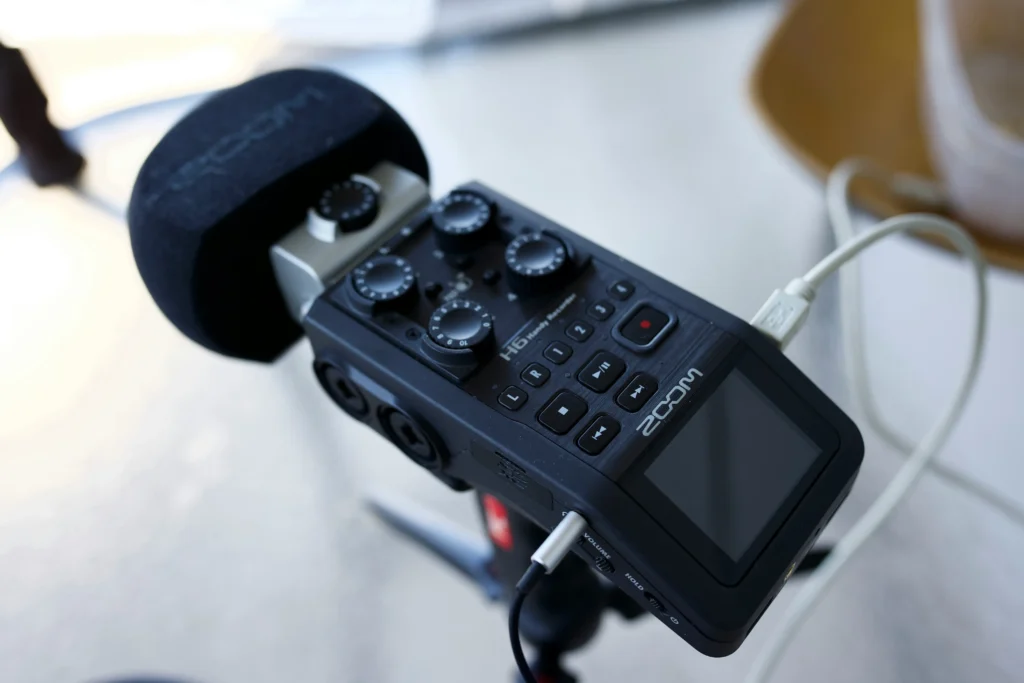
| Zoom H6 essential | 32-bit Float / 96 kHz | 4 x XLR/TRS combo + 3.5mm jack | X/Y Removable Stereo | Up to 9 hours (AA batteries) |
| Zoom H1n (Legacy) | 24-bit PCM / 96 kHz | 1 x P2 Mic/Line In | Fixed Stereo X/Y ($90^{\circ}$) | Up to 10 hours (AAA batteries) |
| Zoom H5 (Legacy) | 24-bit PCM / 96 kHz | 2 x XLR/TRS combo | X/Y Stereo Interchangeable | Up to 15 hours (AA batteries) |
The consolidated data indicate that conducting a Zoom portable recorder test It involves choosing the hardware according to the complexity of the musical group that you intend to record.
Models with essential technology eliminate bureaucratic leveling steps, while more robust versions operate as true multi-track audio interfaces for portable home studios.
How do the combined XLR/TRS inputs expand the usefulness of the recorder for advanced line instrument studies?
The presence of combo connectors allows you to connect balanced XLR cables from professional microphones and quarter-inch TRS cables from electric instruments directly to the device.
This versatility makes it possible to isolate the signal from a bass or keyboard line while the top microphones record the natural acoustics of the room.
Read more: How to use a loop station for practice and gain accuracy.
Isolating sound sources into separate digital tracks facilitates subsequent editing work, allowing you to increase the volume of a specific instrument that was too quiet during the performance.
The music student gains a clean study material, ideal for practicing improvisation techniques over the recorded backing track.
When should you use loop repetition and speed-change functions without changing pitch in your daily practice?
Activating the time manipulation tools helps in decoding fast guitar solos, complex bass phrases, or intricate drum fills in classical pieces.
The recorder's internal processor slows down the playback of the audio file without altering the original pitch of the musical notes recorded in the field.
Learn more: Techniques for singing and playing an instrument at the same time
The student isolates a difficult segment of a few seconds using electronic time markers, configuring the device to repeat the fragment continuously at a reduced speed.
As muscle memory absorbs the note patterns, the audio speed is gradually increased until it reaches the original tempo of the composition.
The Impact of High Fidelity on the Technical Development of Musicians
Establishing a productive study routine requires confronting one's own musical performance with the maximum descriptive realism that digital tools can currently offer.
Read more: Best free apps for studying music at home
Analytical recording acts as an impartial sonic mirror, revealing tempo flaws, unintentional pitch fluctuations, and dynamic imbalances that go unnoticed during a live performance.
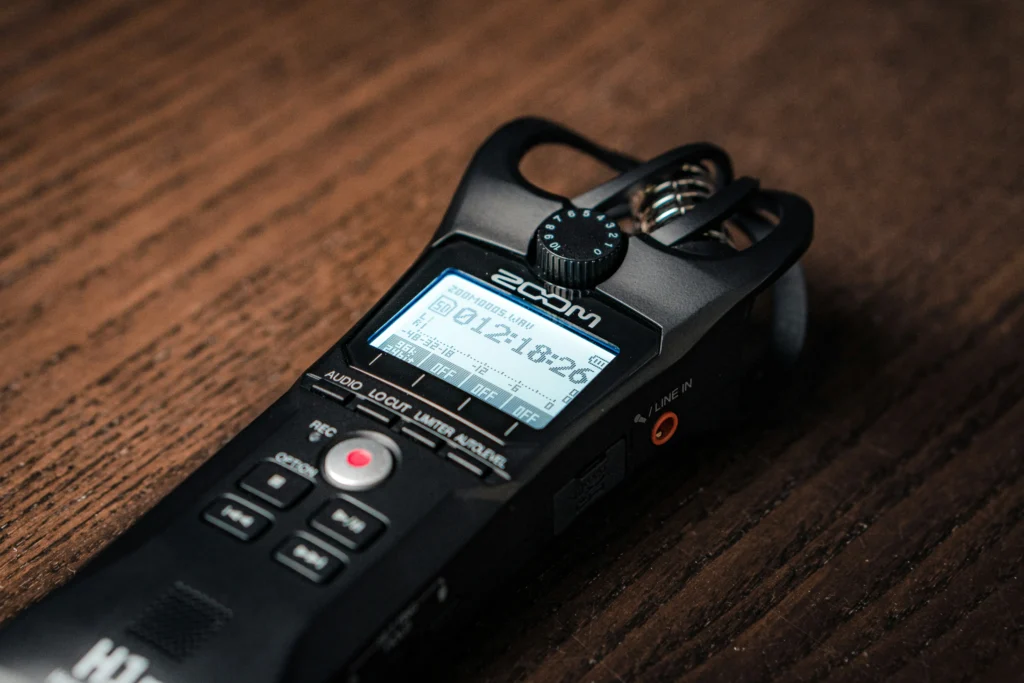
Investing in dedicated audio equipment accelerates artistic development by eliminating technical distractions and external noises that sabotage students' concentration during listening sessions.
Technology acts as a silent mentor, refining acoustic perception and raising the standards demanded of music professionals.
To access up-to-date equipment catalogs, detailed firmware manuals, and technical support documentation for mobile recording systems, please visit the international portal of [Company Name]. Zoom Corporation.
Frequently Asked Questions (FAQ)
Can I use the Zoom portable recorder as the main microphone for live streaming on my computer?
Yes, most current models have a native USB-C audio interface that allows you to transmit sound from the cartridges in real time.
The computer recognizes the device automatically, eliminating the need to install complicated external drivers in modern operating systems.
What is the real advantage of the WAV audio format over the compressed MP3 format in rehearsals?
The WAV format records audio without data compression, preserving all the original frequencies and dynamics of the musical performance intact on the storage medium.
The MP3 format subtly discards acoustic information to reduce file size, which hinders the detailed analysis of delicate timbres during studies.
What happens if I forget to turn off the recorder and the batteries die in the middle of an important recording?
Modern models that use 32-bit float recording technology automatically close and save the audio file as soon as they detect a critical drop in battery power.
This security protocol prevents corruption of the digital file, preserving all captured content up to the exact moment of shutdown.
Is it necessary to use "deadcat" type windscreens when filming inside closed rooms?
Inside closed, acoustically controlled rooms, the use of long-pile windshields is unnecessary, as simple foam is sufficient to contain blasts of air from voices.
The "deadcat" type accessory becomes mandatory only in outdoor recordings to neutralize severe noise caused by direct wind gusts on the capsules.
