
Discover the Viking tagelharpa and its unique, ancient sound.
The historical rescue of Viking tagelharpa It has established itself as one of the most expressive cultural movements in contemporary folk music and experimental archaeology worldwide in the year 2026.
Advertisements
This bowed string instrument evokes medieval Nordic landscapes through its dense, hypnotic, and profoundly melancholic sound.
Throughout this technical article, we will explore the manufacturing secrets and history of this ancient lyre.
We will analyze its traditional physical structure, the raw materials used, the main musical performance techniques, and the resurgence of the instrument in global pop culture.
What is a horsehair lyre and what is its historical origin?
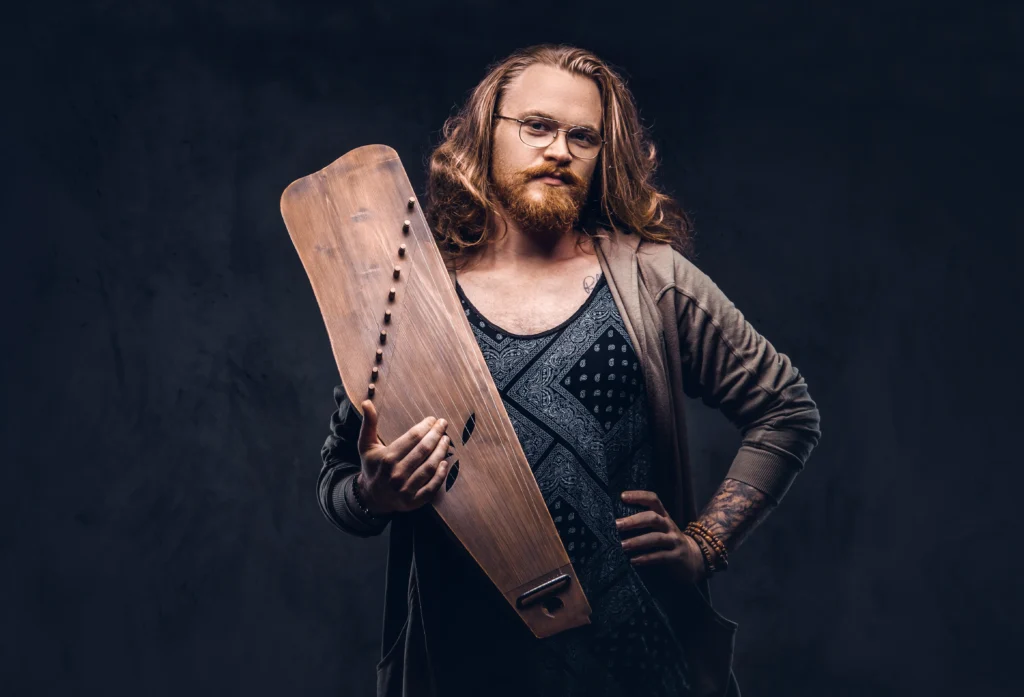
This ancient musical instrument consists of a soundbox carved from blocks of wood, traditionally lacking a fingerboard for pressing the strings.
Advertisements
Its most striking structural feature is the presence of a rectangular opening at the top where the musician positions their fingers to modulate the notes.
Archaeological records indicate that variants of this chordophone were widespread throughout the Scandinavian and Baltic regions and the islands of Western Europe during the Middle Ages.
The original name derives from a combination of the old words for horsehair and harp, highlighting the resources available at the time.
The direct association of this piece with the era of Scandinavian warriors gave rise to the term that has become commercially popular in the contemporary international scene.
Understanding the liturgical and festive context of Viking tagelharpa It allows us to appreciate the rudimentary acoustic engineering that defied centuries of musical and technological evolution.
How does the acoustic mechanics and tuning of the instrument work?
Unlike modern violins, the strings of this instrument are not pressed against a hardwood fingerboard to alter the usable vibrating length.
The musician uses the sides of their fingers or their fingernails to pluck strings suspended perpendicularly in the air, requiring precise motor skills.
The friction bow, often tensioned by the player's own hand during performance, is rubbed against horsehair strings that have been previously coated with porous vegetable rosin.
This continuous friction generates a characteristic sound rich in low harmonics and rustic textures that mimic the Arctic wind.
| Structural Component | Traditional Materials Used | Main Acoustic Function | Impact on the Final Tone |
| Sound Box | Dried pine or fir wood | Amplify the vibrations of the strings. | It projects warm, dry, and deep tones. |
| Strings | Braided horsehair | To produce the fundamental frequency. | It generates a characteristic and ancestral hissing sound. |
| Friction Arc | Bent birch branch | Initiate continuous vibratory stimulation. | It allows for rhythmic dynamics and rituals. |
| Easel | Lightweight birch or bone wood | Transferring mechanical energy to the top | It defines the volume and sustain of the notes. |
What are the ideal woods for luthier construction?
Contemporary craftsmen use Nordic pine or fir for making soundboards due to the excellent speed of sound propagation of these plant species.
The instrument's body can be carved from solid blocks of birch, linden, or maple, ensuring long-lasting structural stability against temperature variations.
The natural drying of the wood over several years prevents future warping caused by the high mechanical stress exerted by the conical tuning pegs.
Each choice of material subtly alters the harmonic balance, allowing the construction of pieces with customized timbres for professional studios.
The handcrafted production respects traditional methods of cutting and biological gluing, using natural resins extracted from native trees of boreal forests.
To explore comprehensive archaeological studies on medieval stringed instruments from Scandinavia, consult the collection of... National Museum of Denmark.
This technical dedication reconnects modern musicians to the essence of Viking tagelharpa with impeccable historical accuracy.
Why is horsehair irreplaceable in ropes?
Synthetic nylon or steel strings offer greater tuning stability under high humidity conditions, but sacrifice the organic character of the instrument.
The microscopic structure of natural horsehair features cuticular scales that grip the arch in an irregular way, creating a multifaceted and unique vibration.
The manufacturing process requires selecting long strands from stallions' tails, as the urine of mares tends to weaken the keratin in the natural fibers.
Read more: Urucungo: The Ancestor of the Berimbau in Afro-Brazilian Traditions

The yarns are washed, hand-braided into groups of varying thicknesses, and stretched under controlled heat to standardize elasticity.
Maintaining pitch requires patience from the musician, as the animal fibers constantly react to temperature fluctuations and hand perspiration during long concerts.
This inherent instability is part of the instrument's own expressive identity, making each artistic performance a unique event impossible to replicate.
When did the instrument experience a resurgence in international pop culture?
The commercial resurgence of this medieval stringed instrument gained global momentum with its inclusion in the soundtracks of historical television series and video games set in Norse mythology.
Modern neofolk bands have integrated acoustic instruments with industrial electronic synthesizers, creating a highly successful musical subgenre.
This revival movement spurred European festivals dedicated exclusively to cutlery, archery, weaving, and faithful historical reconstruction of instrument making.
Learn more: Discovering the Rebab: An Ancient Chordophone Present in Many Cultures
Today, young musicians from all over the world commission replicas to explore new sonic textures in heavy metal arrangements, film scores, and meditation.
The popularization of Viking tagelharpa It expanded the academic boundaries of musicology, encouraging new studies on the oral traditions of ancient Baltic communities.
To understand the policies for preserving the intangible cultural heritage of humanity and folkloric manifestations, visit the portal of... UNESCO. Access to these records validates the importance of keeping the artistic expressions of the past alive.
The enduring nature of sound that transcends centuries.
The renewed interest in the expressive tools of antiquity demonstrates that the human quest for profound connections transcends the conveniences of contemporary digital technology.
The echo of the horsehair strings transports us to a time when music was integrated into natural cycles and community rituals.
Read more: Discover the oud, an ancient Arabic instrument.
Study the history of stringed instruments, support independent luthiers dedicated to this art, and experiment with ancient modal tunings in your musical compositions.
By valuing this traditional knowledge, we ensure that the history of music continues to be told through pure, mysterious, and genuinely inspiring sounds.
Frequently Asked Questions about Tagelharpa
What is the standard tuning used on this Nordic instrument?
The most common tuning is modal in fifths or fourths, frequently using the notes D-A-D or A-D-A, allowing for the playing of continuous drone notes.
Is it very difficult to learn to play if I already play the cello?
The transition requires adaptation, as the absence of a mirror forces you to use your fingernails or fingers to stop the strings suspended in the air.
How should I store the instrument to protect the horsehair?
Store the item in rigid cases with humidity control using silica gel, avoiding direct sunlight or excessively dry and hot environments.
How many strings does a version considered historically accurate have?
Most traditional models and archaeological finds feature three ropes, although regional variations exist that are constructed with two or four horsehair ropes.
