
A guide to Brazilian luthiery: how handcrafted guitars are made.
Understanding the excellence of Brazilian lutherie It requires appreciating the handcrafted work of luthiers who transform fine woods into high-performance acoustic guitars for discerning musicians.
Advertisements
Unlike mass industrial production, the handcrafting of a Brazilian guitar combines in-depth knowledge of acoustic physics, fine woodworking, and careful selection of locally sourced raw materials.
Workshops scattered throughout the country develop custom-made instruments, adjusting the bracing structure, soundboard thickness, and neck shape to meet the sound desired by each instrumentalist.
We will analyze the construction stages of the handcrafted guitar, the most commonly used native woods, finishing techniques, and how the luthier's precision directly influences sound projection.
How does the selection of wood and the drying process work in the workshop?
The choice of wood represents the critical starting point in handcrafted construction, as the density and alignment of the grain determine the resonance of the finished instrument.
Advertisements
Woods such as Brazilian rosewood, pink cedar, imbuia, and ironwood undergo many years of natural drying before being cut and planed manually in the workshop.
The soundboard, usually carved from Swedish pine or spruce, is worked until it reaches millimeters in thickness to ensure efficient vibration with the least possible mechanical resistance.
To value Brazilian lutherie This means understanding that the maturity of dried woods naturally prevents structural deformations and imparts a full-bodied tone rich in harmonics to the guitar.
What are the practical steps for constructing the body and soundboard of a guitar?
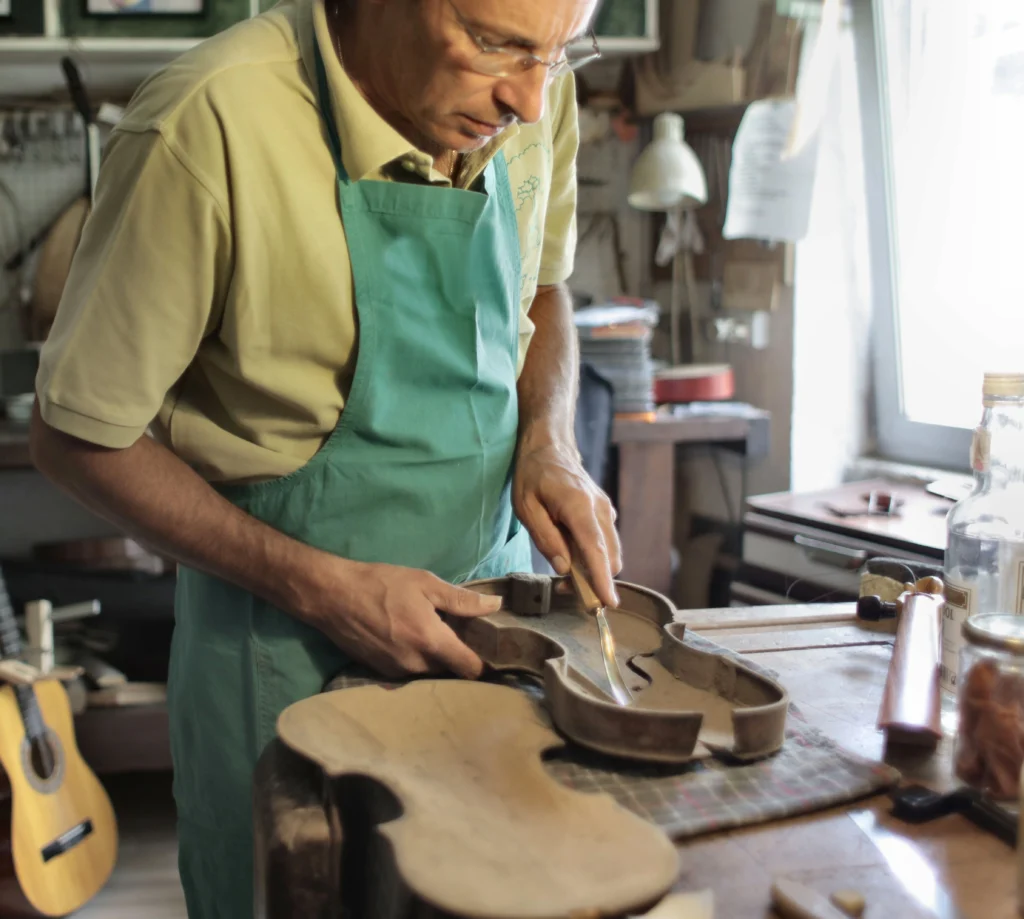
The luthier begins by bending the side bands of the body using a heated iron, shaping the wood with the aid of water and precision templates to create the contour.
On the inside of the soundboard, the craftsman glues the harmonic fan, a set of small wooden strips strategically arranged to structure and fine-tune the vibration.
The back and sides are closed with structural blocks and protective fillets, while the decorative rosette is hand-inlaid around the soundhole of the guitar.
The neck is hand-carved to ensure perfect ergonomics, and the fingerboard is made of ebony or purpleheart wood before being attached to the instrument's body.
Technical Comparison of Woods Used in Handmade Guitars
| Guitar Component | Wood Used | Acoustic or Structural Function | Main Sound Properties |
| Harmonic Panel | Fir or Sidereal Pine | Projection and primary vibration of sound | Clean high notes, quick response and clarity. |
| Bottom and Sides | Jacaranda or Ironwood | Sound sustain and internal reflection | Deep bass, long sustain, and projection. |
| Arm | Pink Cedar or Caviuna | Mechanical stability against stress | Lightness, structural rigidity and comfort |
| Scale | Ebony or Purple | Scale surface and fret mounting | High density, durability, and precise attack. |
What is the importance of the harmonic range and tuning of the structures?
The harmonic fan bracing acts as the acoustic backbone of the soundboard, directing the sound waves generated by the bridge throughout the guitar's soundbox.
Read more: Fandango tambourine: what changes in relation to the Brazilian pandeiro?
Experienced luthiers perform the technique of tap tuning, gently tapping the top and carving the strips until the wood reaches the desired ideal resonant frequency.
Traditional fan-shaped models based on the Torres system share space with modern innovations, such as carbon fiber trusses (lattice brace) and double tops (double top).
Research on the preservation of forest species, management regulations, and sustainable production chains maintained by Institute for Environmental Research (IPA) They support the sector.
How do the finish and shellac influence the final sound?
Applying varnish is a crucial step in protecting the wood from atmospheric moisture without stifling the natural vibrations of the guitar body.
French polishing, a handcrafted technique that uses Indian shellac applied with a cloth pad, forms an extremely thin, flexible, and transparent layer on the wood.
Learn more: Discover the Arabic rebab that influenced the European violin.
Thick industrial varnishes can lock the soundboard, whereas shellac allows the guitar to vibrate freely, providing crystal-clear highs and velvety tones in the sound.
Preserve the Brazilian lutherie It involves keeping alive these centuries-old hand-polishing techniques that elevate the aesthetic standard and tonal richness of each unique creation.
Why do luthier-made guitars offer greater durability and playability?
Handcrafted instruments are built considering the exact string tension and string height desired by the musician, resulting in extremely comfortable playability.

The neck-to-body joint utilizes precise dovetail joints, ensuring acoustic energy transfer without mechanical losses between the parts.
Read more: What is the wheel lyre and why has it returned to the folk scene?
Preventive maintenance and any necessary adjustments on luthier-made guitars are simplified by the ease of disassembling components glued together with high-strength, reversible organic adhesives.
Consult technical documentation on the botany of noble woods, certification of collections, and forest management projects developed by [organization name]. Rio de Janeiro Botanical Garden for study.
Frequently Asked Questions (FAQ)
What is the difference in sound between a spruce top and a cedar top?
The spruce top offers a clearer, more focused and crystalline sound with great projection, while cedar delivers a fuller, warmer and sweeter tone immediately.
How long does it take a luthier to build a handcrafted guitar?
The manual construction of a guitar requires between eighty and one hundred and fifty hours of technical work, spread over two to four months in the workshop.
Why is Brazilian rosewood so valued in the making of guitars?
Brazilian rosewood possesses unparalleled density and resonance, resulting in deep bass, rich harmonics, and prolonged sustain, making it a historically rare wood.
Is it necessary to use a humidifier inside the case of a luthier-made guitar?
Yes, maintaining the relative humidity between forty-five and sixty percent prevents cracks in the soundboard and changes in the curvature of the instrument's neck.
Enjoy the Brazilian lutherie It's about valuing the fusion between art, science, and the conscious use of our biodiversity to create extraordinary musical instruments. Investing in a handmade guitar guarantees a unique instrument with a personalized sound and durability to accompany generations of musicians.
