
How to use artificial intelligence in music to study better.
To know How to use artificial intelligence in music to study better. It has gone from being a luxury reserved for futuristic studios to becoming a reality for those who no longer want to waste hours on empty repetitions.
Advertisements
Current technology is not just for automating processes; it acts as a silent tutor, offering that "perfect pitch" that many of us have spent decades trying to hone.
In this guide, we'll get straight to the point: how to transform algorithms into your greatest allies in the pursuit of technical mastery.
The big turning point happens when we stop seeing technology as a cheat and start viewing it as a sonic microscope.
Integrating these tools into their routine allows musicians of any level to identify articulation flaws or micro-out-of-tune notes that the human ear, often accustomed to its own performance, misses.
Advertisements
Let's understand how to apply this processing power to accelerate your evolution in a practical and honest way.
Why has technology changed the game in music education?
Traditional learning has always been a solitary journey and, let's be honest, often frustrating. The average student practices during the week and only discovers that they have developed a bad fingering habit or a flawed rhythmic interpretation in the next lesson with the teacher.
Artificial intelligence solves this critical gap by offering an immediate diagnosis, preventing the error from becoming a habit.
It's fascinating to observe how digital accessibility has democratized technical rigor. Today, having a smartphone at your music stand is like having a spectral analysis assistant at your disposal.
THE Artificial intelligence in music for better study. It doesn't replace artistic sensitivity, but it removes the "noise" from the learning process, allowing you to focus on expression while the machine takes care of the mathematical precision of the sound.
How do audio isolation tools make life easier?
If you've ever tried to learn a guitar solo by ear with the drums and keyboard "overpowering" the guitar frequencies, you know what I'm talking about.
In the past, this required an almost Herculean effort of concentration.
Currently, algorithms of Source Separation (source separation) can cleanly slice a finished song into isolated tracks of vocals, bass, and instruments.
By muting your instrument in the original song, you create a luxurious "backing track" where you take the place of your idol.
This guided imitation is one of the quickest ways to absorb the phrasing and dynamics of someone who has already achieved that.
It's the end of guesswork: you hear every breath and every pick attack with a clarity that was previously exclusive to those who possessed the studio's master tapes.
Where does the danger (and the benefit) of real-time feedback lie?
Practicing with apps that “listen” to you can be both a humbling and liberating experience.
These systems compare your performance to the digital score and are unforgiving: if you're even a millimeter out of tune or a millisecond late on the attack, the screen will tell you.
This ruthless correction is what generates true precision, transforming muscle memory into something far more reliable.
Learn more: A practical guide to using tuning apps correctly.
For singers, this visualization of the vocal curve is a game-changer, allowing them to adjust resonance without relying solely on physical sensation, which can be misleading.
Prestigious institutions, such as those listed in the curricula of Berklee Online, They already incorporate these analyses so that the student understands the physics behind the grade.
The AI here functions like a teacher on call 24/7.
AI tools: Where to focus your effort
| Functionality | Impact on the Study | Suggested Tools |
| Stem Isolation | Surgical transcription and playback creation | Moises.ai, LALAL.AI |
| Pitch Monitoring | Fine-tuning of intonation and muscle memory. | Singscope, Yousician |
| Dynamic Monitoring | A generation of rhythms that "feel" their time. | Band-in-a-Box, Chord AI |
| Harmonic Mapping | Instant decoding of harmonic fields | Chordify, Moises |
How do you structure a routine that doesn't make you dependent on others?
The biggest mistake is letting the tool dictate what you should do. Always start with an "analog" technical goal, such as mastering a difficult chord transition, and use AI only to validate your progress.
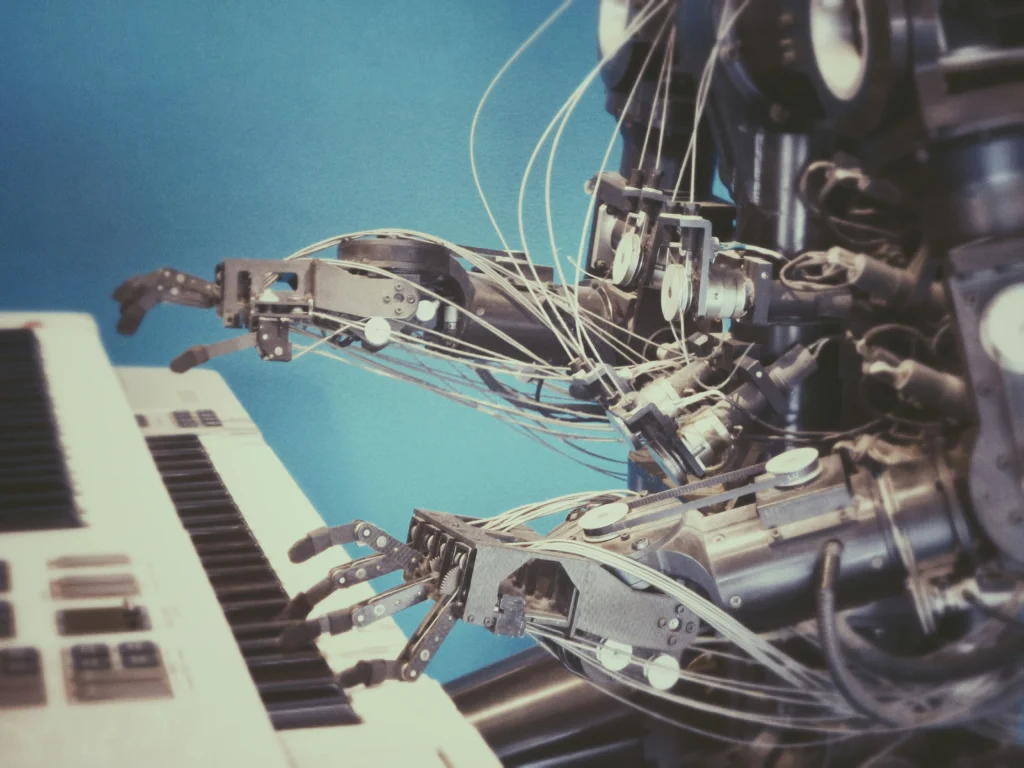
THE Artificial intelligence in music for better study. It should be the thermometer, not the weather. Set your smart metronome to punish your hesitations and reward your rhythmic consistency.
Set aside some time during your workout to analyze the performance reports that these apps generate.
Learn more: Best free apps for studying music at home
Visualizing graphically that you consistently mistuned the same note in the third octave is far more productive than playing the entire song repeatedly and hoping the problem will disappear on its own.
Attack the vulnerability where it hides, using the data as your war map.
The use of AI in composition as a pedagogical tool.
Studying composition with the help of algorithms doesn't mean giving up your creativity; it's about expanding your vocabulary.
When a tool suggests a harmonic substitution that you would never consider, it's teaching you a new rule (or how to break it).
Analyzing why a machine suggestion sounds good, or terribly bad, is an exercise in advanced music theory.
Read more: How to apply sensory music therapy at home with children.
By observing how a digital assistant handles voice commands, you end up absorbing patterns that would take months to find in books.
The idea is to use these drafts as starting points for your own explorations.
Technology is an extender of possibilities, a way to test ideas in seconds before investing hours polishing something that might not work in the context of the project.
Seeking sources and maintaining artistic integrity.
Musical evolution in 2026 demands a sharp critical filter. With so many options available, it's tempting to fall into superficiality.
Always look for tools that are based on real audio signal processing and avoid promises of "effortless learning".
Effort is where learning resides; AI simply ensures that this effort is not wasted in the wrong directions.
THE Artificial intelligence in music for better study. It's an invitation to excellence, as long as you keep your ear trained for what the machine can't measure: the feeling and the intention.
An excellent point of reflection on how to balance these two forces is to follow the work of International Society for Music Education, who has been leading the debate on ethics and technique in modern education.
Frequently Asked Questions (FAQ)
Will AI make me "lazy" about learning songs by ear?
Only if you allow it. Use the tool to check what you've already tried to do on your own. The software should be the answer key for the test, not a cheat sheet under your desk.
What's the best way to get started for a beginner?
Start with track isolation apps. Understanding how each instrument behaves in isolation in a mix is a lesson in arrangement and perception that costs almost nothing and delivers immediate results.
Do these tools work well for acoustic instruments?
Yes, especially in quiet environments. Current processing power can distinguish the timbres of violins, flutes, and guitars with a precision that allows for very refined performance analysis.
Is there a risk of losing the "soul" of music by using so much technology?
The "soul" comes from your interpretation and your choices. AI takes care of the athletic aspects of the music: the tuning, the timing, the clarity. With the technique under control, you are free to focus solely on the emotion.
Musical mastery has always been about controlling sound, and now we have the most powerful tools in history to help us in this mission.
The musician who ignores these advancements is choosing to walk while others are already using high-performance engines.
Adjust your focus, use the data to your advantage, and let artificial intelligence take care of the map while you concentrate on enjoying the sonic journey.
