
Slap techniques on the cajón for Brazilian rhythms.
Mastering the Slap techniques on the cajón It is a true game-changer for anyone wishing to adapt this Peruvian instrument to the rhythmic complexity of contemporary Brazilian music.
Advertisements
In 2026, the cajón ceased to be merely a "stopgap" substitute for the drums and assumed a leading role in high-performance samba, forró, and MPB (Brazilian Popular Music) circles, demanding its own unique language.
What is slap on the cajón and how does it define the timbre?
The slap is that sharp, crisp hit that produces the highest, most snappy note on the instrument, fulfilling the function of a well-tuned snare drum or tambourine.
Unlike bass, which requires a full and relaxed hand in the center, slap requires a "whipping" motion of the fingertips against the upper edge.
In the Slap techniques on the cajón, The secret lies not in the force, but in the angle and the rebound. The hand should act like a whip: the phalanges touch the lid and immediately spring back, preventing the sound from being muffled.
Advertisements
There's something unsettling about the way many beginners strike the wood with stiffness, believing that volume compensates for a lack of technique.
The perfect snap in 2026 is defined by clarity, allowing the percussionist to play for hours without ending the night with aching hands.
How do you use slap bass to simulate a tambourine in samba?
Samba demands that constant subdivision, the "sauce" that gives life to the rhythm.
To mimic the tambourine, the slap technique needs to be performed with the fingers very close together, aiming for a dry, bright note that cuts through the sonic mass of the lower-pitched instruments.
Often, the percussionist alternates between open and muted slap to create "question and response" dynamics.
This is often misinterpreted as mere flourish, but it is, in fact, the basis of Brazilian swing, the rhythm that makes the body move.
When playing a partido-alto, the strategic use of Slap techniques on the cajón It allows you to accentuate setbacks with surgical precision.
This approach transforms the wooden snare drum into a complete percussion section, essential for any self-respecting acoustic setup.
To understand the historical depth of our rhythmic matrices, the portal of National Institute of Historic and Artistic Heritage (IPHAN) It offers fundamental records about samba and its regional variations.
Why is rebound fundamental to speed in forró?
In forró and baião, speed is relentless. Without absolute control over the return movement of the fingers, the quick slap attacks become "dirty" and the rhythm loses its definition.
The cajón here takes on the responsibility of filling in the brilliance that would normally belong to the triangle.
Technical precision allows one to maintain a steady pulse while executing syncopated fills. Mastering the Slap techniques on the cajón In this context, it means, above all, economy of movement.
The less the hand travels, the greater the resistance to endure a fast-paced xote or gallop until the end of the dance.
What are the hand variations for different sound textures?
Not all slaps need to sound the same.
Moving the impact a few centimeters down on the lid creates a medium body, excellent for the smoother dynamics of Bossa Nova, where silence and subtlety are worth more than a snap.
The independence between the left and right hand is what separates amateurs from studio professionals in 2026.
While one hand maintains the rhythmic strumming, the other focuses exclusively on slap accents, creating a polyrhythmic texture that tricks the ears: it sounds like more than one instrument is playing.
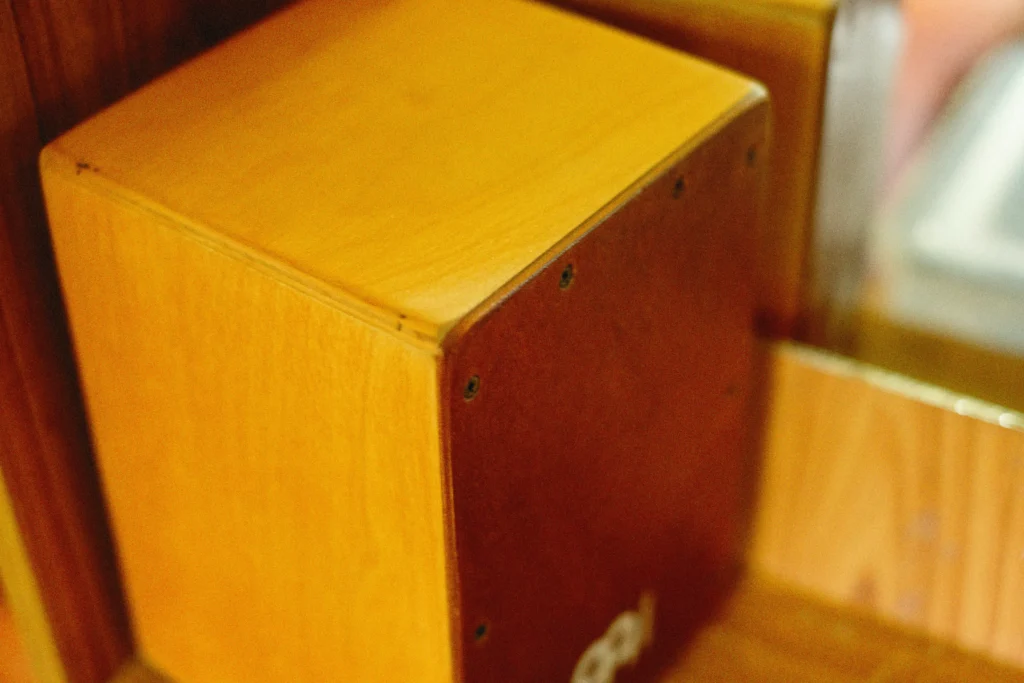
To the Slap techniques on the cajón They ensure you have control over your expressiveness without relying on accessories.
Mastering pure touch is what truly defines a percussionist's sonic identity, regardless of the microphone technique used.
| Technique | Impact Area | Resulting Timbre | Rhythmic Function |
| Slap de Quina | Fingertips on the edge | Cracked and Brilliant | Snare drum / Tambourine |
| Muted Slap | Hand locks the lid. | Dry and Short | Triangle Accent |
| Fingertip | Distal phalanges | Smooth and Defined | Ghost Notes |
| Slap Lateral | Hand side on the corner | Medium Crack | Variation of Repique |
| Simulated Rimshot | Palm on the upper edge | Explosive | Impactful turnarounds |
How to maintain hand health during intensive training?
Playing impact percussion on a hard surface requires respect for the tendons. Warming up before starting slap exercises is mandatory, not optional.
Learn more: We Tested the Cajón Luen Pro: Comfort, Sound and Durability in Practice
Muscle relaxation is not an aesthetic choice, but a physiological survival strategy.
If you feel sharp pain when performing the Slap techniques on the cajón, Something is wrong with its mechanics. In 2026, body awareness is at the heart of performance.
Musicians who ignore posture and rest end up limiting their own creative potential due to injuries that could be avoided with proper technique.
What equipment optimizes slap response on the instrument?
The wood used for the lid dictates the sound. Denser materials deliver a "sharp" slap, while softer woods tend to produce a velvety sound.
Furthermore, the internal string adjustment needs to be up-to-date; a snare that is too loose "swallows" the definition of its snap.
Learn more: Peruvian Cajón vs. Flamenco: Similarities, Differences, and Styles
To perfect the Slap techniques on the cajón It requires an instrument that responds to the most subtle commands.
That's why professionals today prefer models that allow for adjusting the tension of the lid at the upper corners, making it easier to achieve that personalized "corner click".
To delve into the acoustics of materials and the science behind sound, visit the website of Audio Engineering Society (AES) It is the ultimate reference for anyone who wants to understand how audio behaves in practice.
The cajón as the rhythmic heart of Brazil
Mastering slap bass is more than just learning to hit wood; it's about understanding how to translate the soul of Brazilian percussion into a minimalist structure.
The cajón rewards those who dedicate time to technical sophistication with an infinite sonic palette. By applying the Slap techniques on the cajón With discipline and rhythmic sensitivity, you become capable of leading everything from an intimate samba to an energetic forró with the same authority.
Read more: Review: Brazilian Cajón vs. Spanish Cajón
Current percussion is about hybridity and efficiency, and the slap is the key that unlocks that door.
FAQ: Frequently Asked Questions about Slap on the Cajon
How to prevent the bass sound from "leaking" in slap bass?
Precision is everything. Make sure only the tips of your fingers touch the top edge. If your palm touches the wood, you'll activate the bass and lose the brightness of the snap.
Is it normal to feel your fingers swollen after practicing?
There is an adaptation period at first, but excessive swelling indicates brute force. Focus on the whipping motion and the quick return of your hands to protect your joints.
Does slap work at slow tempos?
Absolutely. In Bossa Nova, for example, the slap should be subtle, almost a whisper, simulating the light touch of a brush on the snare drum.
What is the advantage of tilting the cajón?
Tilting the lid improves ergonomics and access to the upper corners. This reduces back strain and allows your arms to work at a much more natural and relaxed angle.
Do long nails interfere with the technique?
Long nails can break or produce unwanted metallic noises. Most percussionists prefer short nails to ensure that contact is only with the pads of the fingers.
