
Best Brazilian songs for practicing tambourine.
Select the best Brazilian songs to practice tambourine. It elevates the percussionist's rhythmic perception, connecting mechanical precision to the cultural flow of samba, choro, and frevo in 2026.
Advertisements
The pandeiro acts as a true pocket drum set, requiring millimeter-precise control of the thumb, fingertip, and heel movements of the striking hand.
Practicing with historical recordings helps the student internalize organic rhythm, going far beyond the cold, linear electronic metronomes.
Our article presents a detailed technical guide to enhance your studies, organizing the repertoire by levels of complexity and emphasis.
Discover how to apply cymbal dynamics and muting to achieve a professional and clean sound.
Advertisements
What differentiates the accentuation of samba and choro in the playing of the pandeiro (Brazilian tambourine)?
Learning choro music requires the musician to master syncopation with surgical precision, valuing silences and quick responses to improvisations from wind or string instruments.
In this style, the tambourine adopts a more restrained posture, functioning as an expressive metronome that embellishes the melodic modulations without overshadowing the soloist.
In contrast, the traditional samba style calls for a heavier emphasis on the bass notes of the thumb, simulating the pulse of the bass drum that marks the strong beats of the measure.
Finding good Brazilian songs to practice tambourine. It helps to understand how this weight transition completely alters the physical dynamics of the hand holding the instrument.
Mastering this alternation of pressures prevents the sound of the cymbals from turning into a continuous noise without rhythmic definition.
Consistent practice with classical references trains the percussionist's ear to identify the exact moment to open or mute the drumhead.
How to begin rhythmic studies using moderate tempos and linear beats?
Beginner students should focus on compositions with a comfortable tempo, between 70 and 85 Beats Per Minute (BPM), to consolidate muscle memory without developing bad posture habits.
Choosing songs with a partido-alto or samba-canção rhythm allows you to isolate the wrist rotation movement before attempting fast repiques (a type of rhythmic strumming pattern).
Consistency of touch matters much more than raw speed in the first few weeks of daily practice on a percussion instrument.
To deepen your knowledge of the history of popular music, biographies of great masters, and collections of original sheet music, explore the... Moreira Salles Institute (IMS).
Keeping the supporting arm relaxed and close to the body reduces the risk of tendinitis and premature fatigue during long study sessions.
Gradually, the mechanical movement becomes a natural reflex, opening space for the introduction of creative rhythmic variations.
What are the ideal compositions for consolidating technique at different learning levels?
Progress in learning percussion depends directly on choosing pieces that challenge motor coordination without causing technical frustration for the student.
To structure your training routine based on real references from our songbook, analyze the technical data structured in the table below:
| Title of the Selected Song | Rhythm / Style | Progress (BPM) | Technical Focus of the Exercise | Difficulty Level |
| The world is a mill. (Cartola) | Samba-Canção | 72 BPM | Thumb stabilization and clean bass. | Beginner |
| Daddy's Little Thing (Beth Carvalho) | Partido-Alto | 96 BPM | Synchronization of syncope and pulse balance | Intermediary |
| Tender (Pixinguinha) | Crying | 80 BPM | Dynamics of cymbals and damping | Intermediary |
| Little Brazilian (Waldir Azevedo) | Quick Cry | 130 BPM | Rebound speed and muscular endurance | Advanced |
Analytical indicators demonstrate that the Brazilian songs to practice tambourine. They offer a complete school of variation in intensity and speed for the musician.
Transitioning between these different BPMs develops the joint flexibility needed to keep up with any choro group or samba circle.
Why does the choice between leather and nylon skin alter your workout routine?
The choice of membrane materials modifies both the physical response of the rebound and the sound projection of the instrument in enclosed environments.
Animal hide skins deliver warm tones and deep bass, making them the time-honored choice for traditional and acoustic choro sessions.
On the other hand, nylon skins offer high projection and resistance to humidity variations, ideal for traditional samba and amplified stages.
Read more: Brazilian Music Without Borders: Traditional Instruments Abroad
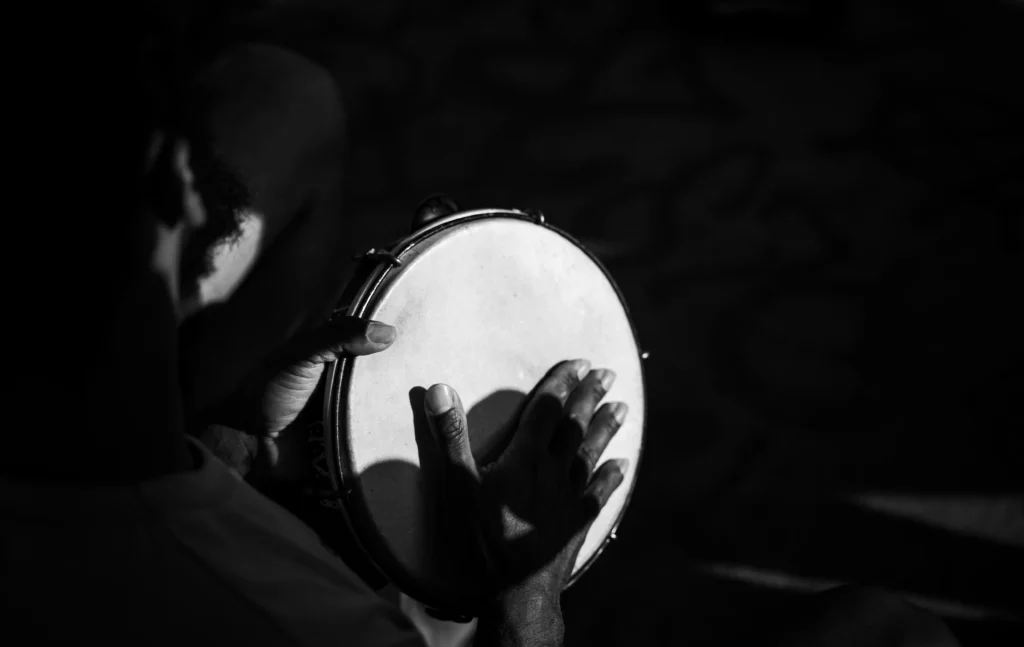
Practicing on an instrument that is out of tune impairs the student's perception, making the correct use of the cross tuning key indispensable.
Adjusting the tambourine by tightening the opposing screws ensures even tension across the entire rim, prolonging the life of the material.
Experiment with different tensions to discover which rebound response best suits the speed of your attacking hand.
When should juggling and visual effects be introduced into the performance of the levadas?
Embellishments and aesthetic twists should only appear when the basic rhythm is completely internalized and flowing without tempo fluctuations.
Adding cuts and scrapes too early breaks the rhythm's flow, hindering the performance of the other musicians in the group.
Learn more: Afoxé and Its African Roots in Brazilian Music
Use visual effects subtly, emphasizing phrase transitions or the introductions to the main verses of the musical composition.
A good pandeiro player stands out for their ability to lead the group with firmness, acting as the beating heart of the harmony.
The Impact of Percussion on Brazilian Musical Identity
Playing the pandeiro (Brazilian tambourine) transcends mere technical learning, representing a deep dive into the historical roots that shaped our rhythmic richness.
Read more: African instruments that inspired Brazilian music.
Daily dedication to the instrument refines aesthetic perception and preserves centuries-old traditions that connect generations through the touch of the skin and the cymbals.
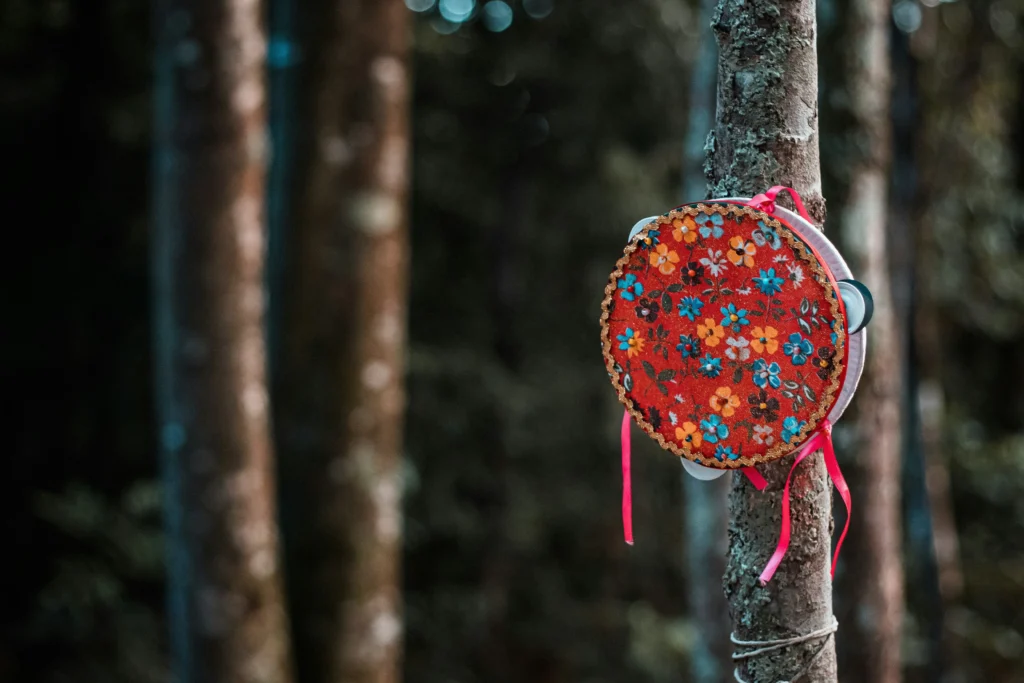
The combination of methodical discipline, attentive listening to the classical repertoire, and respect for the masters of the past transforms the student into a complete musician.
By mastering these rhythmic cells, we keep the flame of our culture alive, ensuring its evolution and relevance in contemporary musical landscapes.
To search for digitized sheet music, percussion teaching methods, and rare phonographic recordings of national history, consult the digital collection maintained by [organization name]. National Library of Brazil.
Frequently Asked Questions (FAQ)
How can I eliminate wrist pain in the hand that holds the tambourine during practice?
The pain usually results from excessive force when holding the instrument or from an excessively rigid posture of the supporting arm.
Keep the tambourine at an angle of approximately forty-five degrees and use the movement of your own body to cushion the weight of the rim.
What is the function of the small springs or dampers placed between the cymbals?
These accessories are used to control the vibration time of the metal, reducing the excessive sustain of the high-pitched sound of the cymbals.
Muting the jingles ensures a cleaner and more defined sound, preventing the tambourine from becoming muddled in studio recordings.
Is it possible to learn to play the pandeiro (Brazilian tambourine) by studying only with a digital booklet?
The textbook provides the theoretical basis and diagrams of the movements, but it should be used in conjunction with careful listening to the original recordings.
Watching videos of experienced percussionists helps to understand the rhythm and flexibility of the wrist that sheet music cannot fully capture.
How can I protect my leather tambourine from the effects of hand sweat?
After each training session, clean your skin and pads with a dry cotton cloth to remove the acidic moisture from sweat.
Store the instrument in a padded case and avoid leaving it exposed to direct sunlight inside the car, as this would cause the leather to dry out prematurely.
